Sticky vs Rotating Sessions: Which Proxy Session Type to Use
Choosing between sticky and rotating proxy sessions is a fundamental decision that dictates the success of your automated web workflows, account management…
In this article
- Defining Sticky Sessions and Performance Characteristics
- The Mechanics of Rotating Proxies
- Comparison Table: Sticky vs. Rotating Sessions
- Use Cases for Sticky Sessions
- Use Cases for Rotating Proxies
- Technical Implementation: Code Examples
- Benchmarks and Performance Metrics
- Performance Benchmarks (Averages)
- How to Avoid Detection in Both Modes
- Recommended Deals
- Choosing the Right Provider for Your Session Needs
- Balancing Cost vs. Efficiency
- FAQ
- When should I never use rotating proxies?
- How long can a sticky session actually last?
- Do rotating proxies help with CAPTCHAs?
- Is there a limit to how many sticky sessions I can have?
- Conclusion
Choosing between sticky and rotating proxy sessions is a fundamental decision that dictates the success of your automated web workflows, account management efficiency, and data scraping reliability. While both session types utilize residential or datacenter backconnect pools, the logic governing how and when the IP address changes creates a massive difference in how target servers perceive your requests.
Defining Sticky Sessions and Performance Characteristics
A sticky session, often referred to as a "session-persistent" proxy, allows a user to maintain the same IP address for a specific duration or until a task is completed. When you connect to a backconnect gateway with a session ID, the provider attempts to keep you tethered to the exact same residential peer or datacenter node. This is critical for any task that requires "statefulness," such as maintaining a login session on a social media platform or adding items to a retail shopping cart.
Most premium providers, including those found in our Smartproxy review and guide, offer sticky sessions ranging from 1 minute to 60 minutes. The underlying technology relies on a "sticky port" or a specific header sent during the request. Unlike rotating proxies that switch IPs on every request, sticky sessions prevent the "session hijacking" flags that security systems like Cloudflare or Akamai trigger when they see a user's IP change mid-transaction.
The technical stability of a sticky session depends heavily on the "peer" uptime. In residential networks, the IP belongs to a real home user; if that user turns off their router or moves out of Wi-Fi range, the session will die regardless of your settings. Higher-tier providers mitigate this by automatically assigning a new IP under the same session ID, though this can sometimes trigger a logout on the target site.
The Mechanics of Rotating Proxies
Rotating proxies are designed for high-volume, stateless tasks where the primary goal is to bypass rate limits and avoid IP-based blocking. In a rotating configuration, every single request (HTTP/HTTPS) sent through the proxy gateway is assigned a new IP address from the provider's pool. If you are scraping 10,000 product pages from an e-commerce site, rotating proxies ensure that the target server never sees more than a few requests from the same source, making it nearly impossible for them to build a fingerprint and block you.
This "request-based" rotation is the industry standard for SEO audits, price monitoring, and large-scale data harvesting. When using tools like Semrush or Ahrefs for backlink analysis at scale, the rotating mechanism allows for thousands of simultaneous threads without the risk of a "429 Too Many Requests" error. Efficiency is maximized because there is no overhead in maintaining a connection to a specific peer.
Text alternative
graph TD
    A[User Script] --> B[Backconnect Gateway]
    B --> C{Session Type?}
    C -->|Rotating| D[New IP per Request]
    C -->|Sticky| E[Hold IP for X Mins]
    D --> F[Target Website]
    E --> F
    F --> G[Response to User]
Comparison Table: Sticky vs. Rotating Sessions
To better understand the trade-offs, we must look at how these session types handle different metrics such as latency, success rates, and cost-effectiveness. In many cases, using a residential proxy discount can help offset the slightly higher cost of high-quality sticky sessions which often require more bandwidth management from the provider.
| Feature | Sticky Sessions | Rotating Proxies |
|---|---|---|
| Best For | Account Management, E-commerce | Web Scraping, SEO Audits |
| IP Persistence | 1 to 60 minutes | Every request (New IP) |
| Detection Risk | Low (behaves like human) | High (if rate-limited) |
| Success Rate | High for login/carts | High for large data pulls |
| Target Sites | Amazon, Instagram, Google | Competitor sites, Directories |
| Latency | Slightly lower (re-use) | Slightly higher (new handshake) |
Use Cases for Sticky Sessions
Sticky sessions are non-negotiable for "Human-Emulation" tasks. If you are a social media manager using automation tools for Instagram or TikTok, a rotating IP is a death sentence for your accounts. These platforms track the geographical location and ISP of the connecting IP; if your IP jumps from London to New York in three seconds, the account will be flagged for "suspicious activity" and likely shadowbanned.
Another major use case is sneaker botting and retail arbitrage. Websites like Shopify or Nike require a user to log in, browse, add to cart, and check out. This entire tunnel must be completed on a single IP. If the IP rotates during the "Add to Cart" phase, the server's session cookie will often become invalid because it no longer matches the source IP, resulting in an "Empty Cart" error at the payment screen. For these sensitive operations, checking proxytrust.site for verified retail-ready IPs is a standard practice among professional resellers.
Use Cases for Rotating Proxies
If your objective is to gather data from thousands of URLs, sticky sessions are actually a hindrance. Because a sticky session limits you to one IP for a set time, you are bound by that single IP's rate limits. If Google Search sees 50 requests in a minute from one sticky IP, it will serve a CAPTCHA.
Rotating proxies excel here by distributing the load across a pool of millions of addresses. This is the preferred method for:
- Price Comparison: Scraping airline or hotel prices where thousands of combinations must be checked per minute.
- SEO Rank Tracking: Checking keyword positions across hundreds of different regions simultaneously.
- Ad Verification: Ensuring that your ads are appearing on the correct websites without being blocked by ad-fraud detection systems.
- Market Research: Navigating through millions of data points on platforms like LinkedIn or Glassdoor.
For users specializing in high-speed data collection, visiting 5-proxy.com provides insights into high-concurrency pools that support unlimited rotation without throughput throttling.
Technical Implementation: Code Examples
Implementing these sessions typically involves appending a session string to your proxy username. Below is a Python example using the requests library to demonstrate how a sticky session is maintained compared to a standard rotating request.
import requests

# Example for a Sticky Session (30 minutes)
# The '-session-12345' suffix tells the gateway to hold the IP
proxy_sticky = {
    "http": "http://user-name-session-12345:password@proxy.provider.com:8000",
    "https": "http://user-name-session-12345:password@proxy.provider.com:8000"
}

# Example for a Rotating Session (New IP every time)
proxy_rotating = {
    "http": "http://user-name:password@proxy.provider.com:8000",
    "https": "http://user-name:password@proxy.provider.com:8000"
}

# Test Sticky - The IP should remain the same for both calls
print("Sticky Session IP 1:", requests.get("https://api.ipify.org", proxies=proxy_sticky).text)
print("Sticky Session IP 2:", requests.get("https://api.ipify.org", proxies=proxy_sticky).text)

# Test Rotating - The IP should change
print("Rotating IP 1:", requests.get("https://api.ipify.org", proxies=proxy_rotating).text)
print("Rotating IP 2:", requests.get("https://api.ipify.org", proxies=proxy_rotating).text)
Benchmarks and Performance Metrics
When choosing between these types, users often prioritize stability vs. variety. Based on industry testing across residential pools like those listed on proxyip.top, we can observe the following performance trends. Sticky sessions typically have a higher "initial" latency because the gateway has to find a specific available peer, but subsequent requests are faster because the TCP connection can sometimes be reused.
Performance Benchmarks (Averages)
- Rotating IP Success Rate: 99.2% (The gateway simply finds the next available IP).
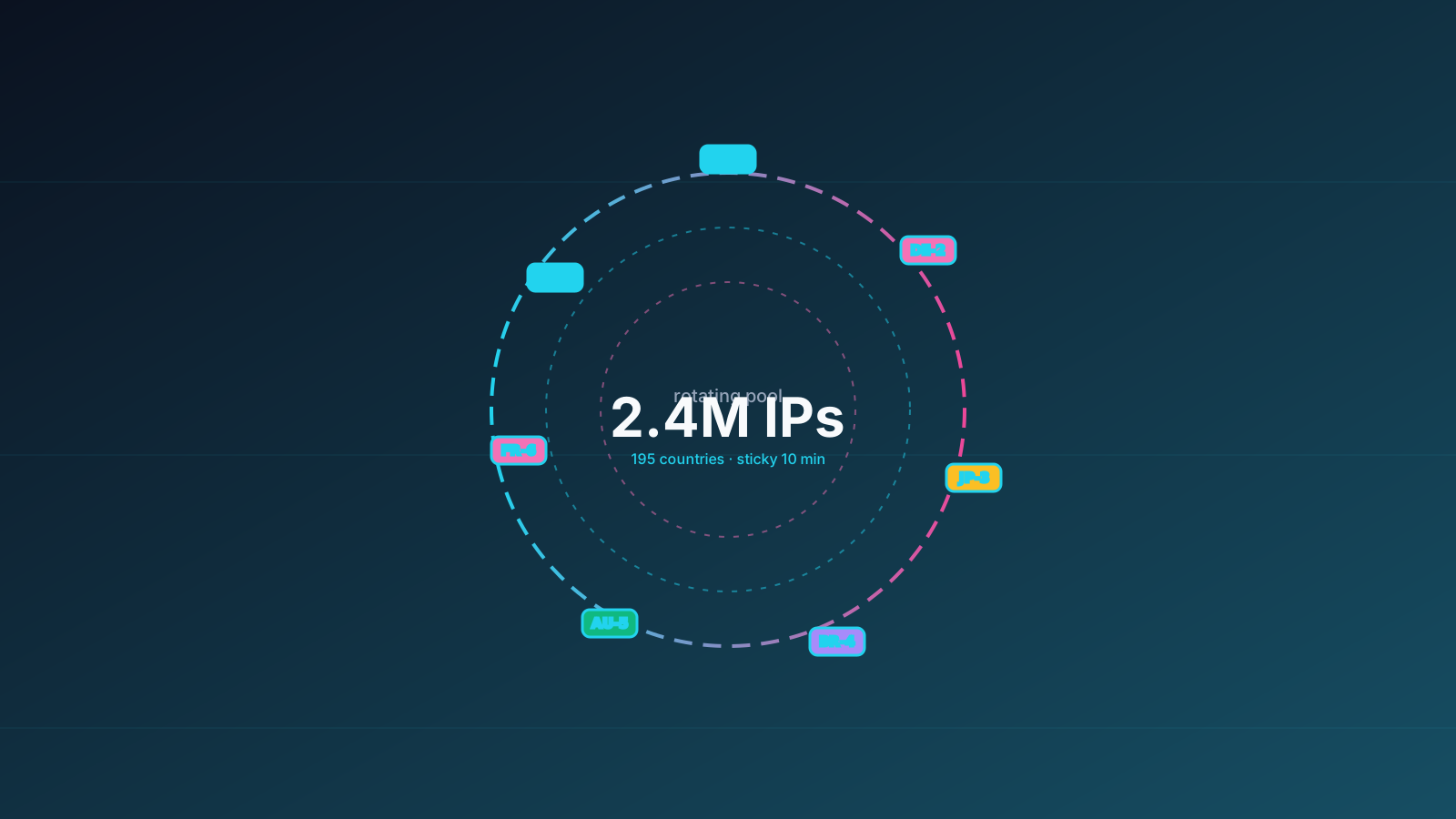
- Sticky Session Stability (10 min): 94.5% (Some peers drop off naturally).
- Sticky Session Stability (30 min): 82.0% (Higher risk of peer disconnection).
- Average Latency (Rotating): 0.8s - 1.2s.
- Average Latency (Sticky): 0.6s - 0.9s (after initial connection).
For those requiring high-uptime sticky sessions, looking at specialized providers on vpsrated.com/proxy can help find those with "Static Residential" (ISP) options, which combine the persistence of a datacenter IP with the reputation of a residential one.
How to Avoid Detection in Both Modes
Regardless of whether you use sticky or rotating IPs, "fingerprinting" is your biggest enemy. Websites do not just look at your IP; they look at your User-Agent, browser headers, WebGL signatures, and even your mouse movements.
- With Sticky Sessions: If you are managing multiple accounts, ensure that each account has its own unique sticky session ID and a unique browser profile. Using a tool like Multilogin or GoLogin in conjunction with your proxies is essential.
- With Rotating Sessions: Ensure your scraper randomizes headers for every request. If you use the same User-Agent with 500 different rotating IPs, the target site will realize it's the same bot and block the entire IP range of the provider.
When scaling up, it is often wise to start with a Smartproxy free trial to test how their IP pool handles your specific target site's anti-bot measures. Different websites have different degrees of sensitivity to IP rotation.
Recommended Deals
- 20% Off All Residential Proxies — Save on high-quality residential traffic for both sticky and rotating needs.
- Smartproxy Free Trial & Special Discounts — Test one of the industry's fastest residential networks with built-in session control.
Choosing the Right Provider for Your Session Needs
Not all providers handle sticky sessions the same way. Some "force" a rotation after a set time, while others allow you to maintain an IP as long as the peer is online.
- Bright Data: Offers the most granular control over sessions, including "Long-term" ISP proxies that can stay sticky for months.
- Oxylabs: Known for massive residential pools and excellent rotation logic for enterprise-level scraping.
- IPRoyal: Excellent for those on a budget who need sticky sessions that don't expire quickly; they are known for their "Royal" residential pool which has high peer stability.
- SOAX: Provides a user-friendly dashboard where you can define session duration down to the second.
For more technical reviews of these providers, our SEO proxy comparison blog post provides a deeper dive into which backends offer the best API integration for session management.
Balancing Cost vs. Efficiency
Sticky sessions are often slightly more expensive in a data-usage model because the provider has to reserve a specific slot in their gateway for your session ID. However, the efficiency gain in "Success Rate" for account-based tasks usually justifies the cost. If you're rotating IPs for scraping, look for providers that charge per GB rather than per IP, as this allows you to rotate through millions of IPs without increasing your bill.
For those just starting, using a residential proxy coupon allows for experimentation. You might find that a 10-minute sticky session is the "sweet spot" for your particular scraping task—long enough to bypass initial security checks, but short enough that you're always getting fresh data perspectives.
FAQ
When should I never use rotating proxies?
You should avoid rotating proxies for any task involving a login or a persistent user state, such as managing social media profiles or checkout processes on e-commerce sites. Frequent IP changes during a logged-in session will trigger security alerts and lead to account bans.
How long can a sticky session actually last?
In a standard residential pool, a sticky session usually lasts between 1 to 30 minutes, depending on the peer's connection. For sessions that need to last days or weeks, you should look into "Static Residential" (ISP) proxies which do not rely on home-user hardware.
Do rotating proxies help with CAPTCHAs?
Yes, they help by preventing the CAPTCHA from appearing in the first place by distributing requests across many IPs. However, if the target site uses advanced behavioral analysis, rotating IPs alone won't solve a CAPTCHA; you may still need a CAPTCHA solving service.
Is there a limit to how many sticky sessions I can have?
Most providers allow you to create thousands of concurrent sticky sessions, provided you have the bandwidth or "port" limit to support them. Each session is simply defined by a different session ID in your proxy configuration string.
Conclusion
The choice between sticky and rotating proxies ultimately boils down to the "state" of your workflow. For stateless scraping, price monitoring, and SEO research, the high-volume diversity of rotating proxies is the clear winner. For account-based tasks, social media growth, and retail-botting, the stability of sticky sessions is mandatory. By understanding the underlying mechanics of these session types and utilizing the right coupons and deals, you can optimize both your success rates and your operating costs. Always test your target site's response to different session lengths before committing to a large-scale data operation.
Get the weekly ProxyPromo brief
Fresh deals, hand-tested codes and honest reviews — every Friday. No spam.