How to Verify If a Proxy Is Ethically Sourced
Navigating the complex ecosystem of residential proxy networks requires more than just checking speeds and price points. For data scientists and enterprise…
In this article
- Understanding the "Ethical" in Ethical Residential Proxies
- The Technical Infrastructure of Proxy Sourcing
- Evaluating Provider Transparency Protocols
- Due Diligence Checklist
- Comparison of Leading Ethical Proxy Providers
- Automated Verification Using Python
- Benchmarking Success Rates and Latency
- Legal and Compliance Risks of Non-Ethical Proxies
- Brand Reputation
- Data Integrity
- The Role of External Audits
- Technical Implementation and Caching
- Recommended Deals
- FAQ
- What is a peer-to-peer (P2P) proxy network?
- How do I know if a proxy is "stolen"?
- Does using ethical proxies prevent me from being blocked?
- Are mobile proxies more ethical than residential ones?
- Final Thoughts on Ethical Sourcing
Navigating the complex ecosystem of residential proxy networks requires more than just checking speeds and price points. For data scientists and enterprise scrapers, the origin of an IP address—the "ethical sourcing" aspect—has become a mission-critical metric for legal compliance, brand reputation, and long-term project stability. Using ethically sourced residential proxies ensures that the end-users whose bandwidth you are borrowing have provided informed consent and are being fairly compensated.
Understanding the "Ethical" in Ethical Residential Proxies
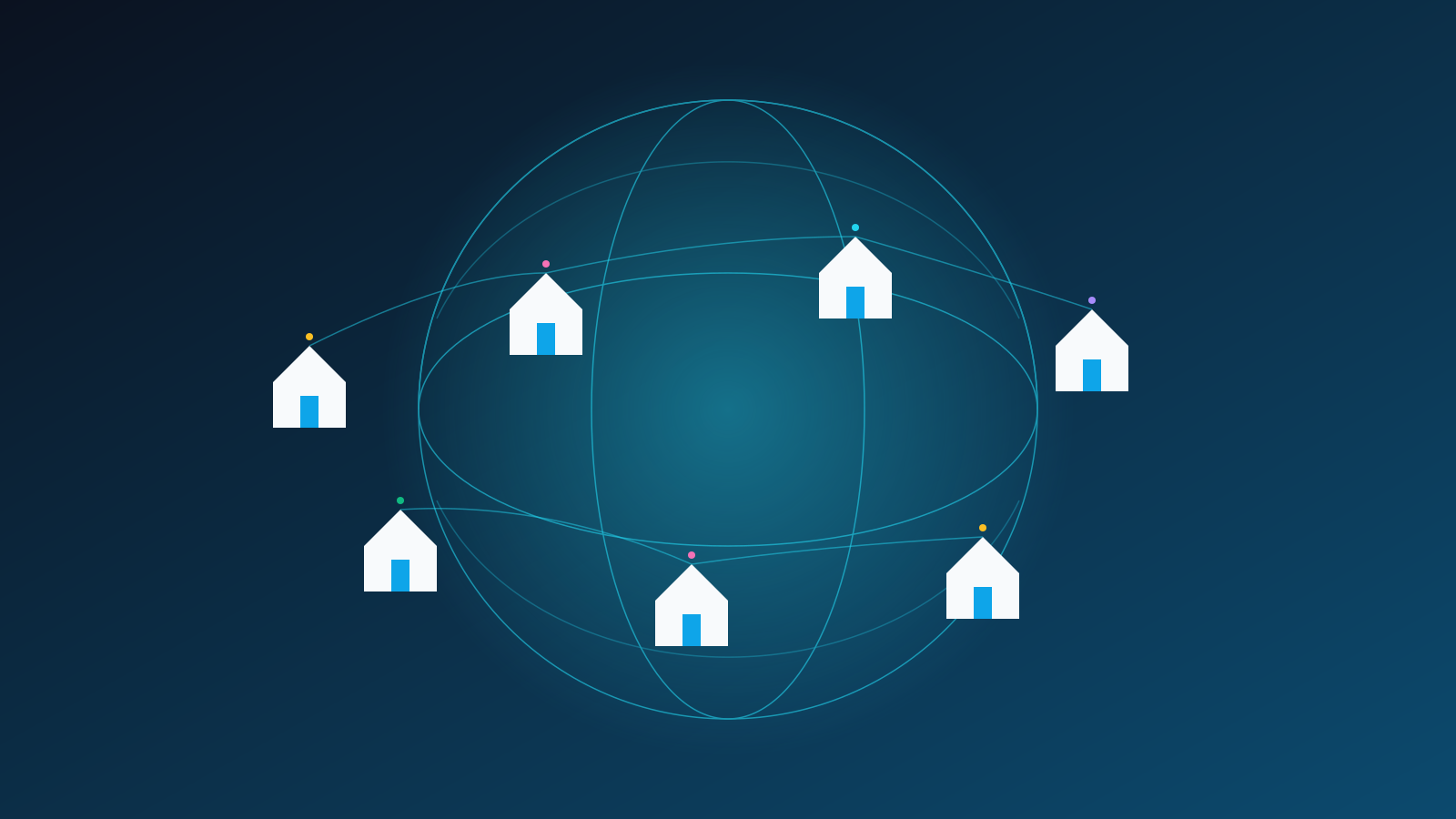
The term "ethical residential proxies" refers to IP addresses assigned to real home internet users who have explicitly agreed to share their connection. In the early days of the industry, many networks were built using "botnets" or malware—software hidden inside pirated games or browser extensions that hijacked a user's bandwidth without their knowledge. Modern ethical providers, such as Bright Data and Smartproxy, have shifted toward transparent SDK (Software Development Kit) models.
An ethical sourcing model must satisfy four primary pillars: informed consent, the right to opt-out, fair compensation, and minimal impact on the user's device (such as only using the connection when the device is idle and connected to Wi-Fi). When you save on residential proxies, you should be certain that your discount isn't coming at the cost of a user's digital privacy or device performance.
The Technical Infrastructure of Proxy Sourcing
To verify a provider's claims, it helps to visualize how the connection moves from your scraper to the target website through a vetted peer. Most top-tier providers use a central gateway that manages rotation and authentication before routing traffic through a residential peer-to-peer (P2P) network.
Text alternative
flowchart LR
  Start[Client Scraper] --> Gateway[Proxy Gateway]
  Gateway --> Auth{Vetting Logic}
  Auth -->|Compliant IP| Peer[Residential Peer]
  Auth -->|Non-Compliant| Drop[Reject Request]
  Peer --> Target[Target Website]
  Target --> Peer
  Peer --> Start
This flow ensures that the traffic is only routed through "clean" nodes. High-quality providers like Oxylabs and IPRoyal maintain rigorous vetting processes for the apps that carry their SDKs. If a provider cannot explain how their peers are recruited, it is a significant red flag for potential legal liabilities under the GDPR or CCPA.
Evaluating Provider Transparency Protocols
Transparency isn't just a buzzword; it is a set of verifiable behaviors. When evaluating a new provider found on proxytrust.site, look for their "Compliance Report" or "Sourcing Policy." A reputable firm will explicitly list the apps or platforms they use to gain consent. For instance, some providers allow users to earn "points" or "credits" in a mobile game in exchange for sharing a portion of their unused upload bandwidth.
Due Diligence Checklist
- KYC (Know Your Customer) Protocols: Does the provider vet you? Ethical providers won't sell to just anyone; they prevent their network from being used for DDoS attacks or fraud.
- Consent Documentation: Does the provider offer a copy of the End User License Agreement (EULA) their peers sign?
- Real-Time Monitoring: Can the provider pinpoint the source of a specific IP if an abuse report is filed?
Sophisticated users often start with a Smartproxy free trial to test the headers and latency of the IPs, confirming they originate from true residential ISPs rather than data centers masked as residential (DCH spoofing).
Comparison of Leading Ethical Proxy Providers
The industry is currently dominated by a few giants who have set the standard for ethical sourcing. The following table highlights how they manage their pools and what makes their sourcing unique.
| Provider | Sourcing Methodology | Pool Size | KYC Required | Ethics Certification |
|---|---|---|---|---|
| Bright Data | Peer-to-Peer SDK / App Owners | 72M+ | Yes | SOC2 Type II |
| Smartproxy | Vetted Third-party Apps | 55M+ | Yes | Self-Audited |
| Oxylabs | Direct Partnerships / Tiers | 100M+ | Yes | Certified Tier 1 |
| IPRoyal | Pawns App (Direct User Base) | 2M+ | Yes | 100% Opt-in |
| SOAX | Mobile & WiFi SDK | 8.5M+ | Yes | Privacy Focused |
Detailed technical reviews on 5-proxy.com often highlight that smaller pools, like IPRoyal's, can sometimes be "cleaner" because they control the entire acquisition software (the Pawns app) rather than relying on third-party developers.
Automated Verification Using Python
You can partially verify the quality and "residential" nature of an IP by querying its ASN (Autonomous System Number) and checking for known proxy headers. While this doesn't prove the user consented, it proves whether the IP is actually a home connection or a deceptive data center IP.
import requests

def check_ip_quality(proxy_url):
    # Test through the proxy
    proxies = {"http": proxy_url, "https": proxy_url}
    try:
        # Querying an IP enrichment API
        response = requests.get("http://ip-api.com/json/", proxies=proxies, timeout=10)
        data = response.json()

        print(f"IP: {data.get('query')}")
        print(f"ISP: {data.get('isp')}")
        print(f"AS: {data.get('as')}")

        # Checking if the ASN is a known Residential ISP (e.g., Comcast, AT&T)
        # Data center IPs often show 'hosting' or 'cloud' in the ISP field.
        if "hosting" in data.get('isp', '').lower():
            print("Warning: This may be a data center IP spoofing as residential.")
        else:
            print("IP recognized as a standard ISP range.")

    except Exception as e:
        print(f"Connection failed: {e}")

# Example usage (Replace with your actual proxy credentials)
# check_ip_quality("http://user:pass@p.smartproxy.com:7000")
When integrating these checks into a large-scale scraping architecture, tools like Semrush or Ahrefs are often used to monitor the ranking stability of your target URLs. If your proxies are "dirty" or unethically sourced, your scrapers will face higher CAPTCHA rates and lower success metrics, significantly increasing the cost per successful request.
Benchmarking Success Rates and Latency
Ethical sourcing directly impacts technical performance. IPs sourced via transparent SDKs tend to stay online longer because the user is aware of the background process and isn't trying to "kill" a suspicious task. Below is a benchmark of average performance metrics based on industry testing available at proxyip.top.
Performance Metrics by Pool Type:
- Opt-in Residential (High Quality):
- Success Rate: 98.4%
- Average Latency: 0.6s - 1.2s
- IP Rotation Stability: High
- Incentivized WiFi (High Quality):
- Success Rate: 95.1%
- Average Latency: 0.8s - 1.5s
- IP Rotation Stability: Medium
- "Black Market" / Botnet (Low Quality):
- Success Rate: 42.0%
- Average Latency: 3.5s+
- IP Rotation Stability: Very Low
Higher latency in unethically sourced pools is often due to the peer being located on a compromised device with a poor connection or the device owner actively using the bandwidth for other tasks. In contrast, providers listed on vpsrated.com/proxy ensure that the SDK only activates when the device has a specific battery percentage and a stable Wi-Fi connection.
Legal and Compliance Risks of Non-Ethical Proxies
The digital landscape is shifting toward strict data privacy laws. Under the GDPR (General Data Protection Regulation), using a European citizen's IP address without their consent could technically make your company a participant in a privacy violation. Fortune 500 companies now require their proxy vendors to prove that every IP in their pool is obtained legally.
Brand Reputation
Imagine a scenario where your price-scraping bot is traced back to a residential IP that was infected with malware to join a proxy network. If that resident investigates, the trail could lead back to your company's headers or user agents. This is why ethical residential proxies are a requirement for enterprise-level operations.
Data Integrity
Non-ethical proxies are often part of "dirty" networks used for spam and fraud. Target websites like Amazon or Google maintain massive blacklists of these IPs. If you use a lower-tier, unvetted provider, your data results may be tainted by "cloaking"—where the target site shows you fake data because it has flagged your IP as a bot. Use providers like NordVPN, ExpressVPN, or ProtonVPN for personal browsing, but for scraping, always stick to vetted residential providers to ensure data accuracy.
The Role of External Audits
The gold standard for a proxy provider is an independent audit. Bright Data, for example, underwent an audit from major accounting firms to verify their sourcing claims. This involves the auditor checking the code of the SDK, the flow of payments to peers, and the internal logs of the gateway.
When browsing for deals, don't just look for the lowest price. A service offering "unlimited residential bandwidth for $10" is almost certainly using stolen IPs. Ethical providers have overhead: they have to pay the developers of the apps they reside in, pay the users, and maintain a global infrastructure for compliance. Websites like proxytrust.site help users distinguish between hobbyist "reseller" operations and professional-grade ethical networks.
Technical Implementation and Caching
To maximize the value of your ethical residential proxies, implement a smart middle-tier. This allows you to reduce the number of requests sent to the proxy network, saving money and reducing the load on the residential peers.
- Header Optimization: Ensure your
User-Agentmatches the type of residential IP you are using (e.g., don't use a Linux Server user agent on a Windows-based residential IP). - Request Throttling: Even with ethical proxies, aggressive scraping can degrade the peer's internet experience. Respect the peers by managing your request frequency.
- Local Caching: Store static assets (images, CSS) locally or on a VPS (check Hostinger for affordable options) so you only use the residential IP for the actual HTML data retrieval.
Recommended Deals
To help you get started with vetted, high-quality providers, we have curated the best current offers in the industry:
- 25% Off Residential Proxies — Get a significant discount on high-quality, ethically sourced residential pools for enterprise scraping.
- Smartproxy Free Trial — Test one of the world's most transparent proxy networks for free before committing to a paid plan.
- IPRoyal Verified Pool — Access IPs sourced directly through their transparent Pawns application at a lower price point.
- Oxylabs Enterprise Discount — Secure the industry leader in ethical sourcing with custom pricing for large data projects.
- Bright Data Starter Credits — Experience the gold standard of audited, compliant proxy networks with a bonus on your first deposit.
FAQ
What is a peer-to-peer (P2P) proxy network?
A P2P proxy network is a system where individual users agree to share their internet connection with the provider. In exchange, the user typically receives a benefit, such as an ad-free experience in an app or direct monetary rewards. This is the foundation of most modern residential proxy pools.
How do I know if a proxy is "stolen"?
While it is difficult to know for certain, red flags include incredibly low prices, a lack of KYC requirements for new customers, and a provider who cannot explain their sourcing methodology. If a provider offers "unlimited" residential data for a flat monthly fee, they are likely not paying their peers, which suggests unethical sourcing.
Does using ethical proxies prevent me from being blocked?
Ethical proxies have higher "trust scores" because they are real residential IPs, but they are not a silver bullet. You still need to manage your scraping behavior, headers, and cookies to avoid being detected by advanced anti-bot systems like PerimiterX or Cloudflare.
Are mobile proxies more ethical than residential ones?
They are generally sourced using the same SDK models. Mobile proxies often have the highest trust scores because thousands of people share the same mobile IP (CGNAT), making it very difficult for websites to block the IP without affecting real customers. Ensure your mobile proxy provider also adheres to informed consent protocols.
Final Thoughts on Ethical Sourcing
Verifying the ethical status of your proxy provider is an investment in your project's longevity. By focusing on providers that emphasize transparency, consent, and fair compensation, you minimize legal risks and ensure higher success rates for your data collection efforts. Always perform your own header analysis and ASN checks to verify that the IPs you receive match the residential profile promised.
For more deep dives into proxy technology and to find the latest verified discounts on the world's best providers, visit our full coupon directory and stay ahead of the competition with clean, reliable data.
Get the weekly ProxyPromo brief
Fresh deals, hand-tested codes and honest reviews — every Friday. No spam.