How to Use Proxies With Selenium for Undetectable Scraping
Modern web scraping requires a sophisticated approach to bypass advanced anti-bot measures like Cloudflare, Akamai, and PerimeterX. Using proxies with sele…
In this article
- Why Proxies with Selenium are Essential for Modern Scraping
- Types of Proxies and Their Impact on Detection
- Integrating Proxies into Selenium WebDriver
- Handling Proxy Authentication and Extensions
- Proxy Performance Benchmarks
- Advanced Stealth: Combining Proxies with Fingerprinting
- Rotating Proxies for High-Volume Scraping
- Common Obstacles and How to Fix Them
- Recommended Deals
- FAQ
- How do I check if my proxy is working in Selenium?
- Can I use free proxies with Selenium?
- Is Selenium slow when using residential proxies?
- What is the difference between SOCKS5 and HTTP proxies for Selenium?
- Maximizing Your Scraping Success
Modern web scraping requires a sophisticated approach to bypass advanced anti-bot measures like Cloudflare, Akamai, and PerimeterX. Using proxies with selenium allows developers to automate browser interactions while mimicking human behavior through IP rotation and geo-location spoofing. This guide explores the technical depth of integrating residential and mobile proxies into Selenium drivers to ensure your scraping fleet remains undetectable.
Why Proxies with Selenium are Essential for Modern Scraping
Selenium is a powerful tool because it renders JavaScript, allowing you to scrape dynamic content that standard HTTP libraries might miss. However, because Selenium interacts with a site exactly like a real user, it also triggers sophisticated tracking mechanisms. Target servers monitor request frequency, TLS fingerprints, and IP reputation. Without a proxy, your local IP is exposed; if you send more than a few dozen requests per minute, you will face immediate blocks or CAPTCHAs.
By routing your Selenium traffic through a proxy server, you create a buffer between your automation script and the target site. This is particularly vital for price monitoring, SEO audits using tools like Semrush, and competitive intelligence. When you combine Selenium's browser automation with a rotating residential proxy pool, each new browser instance appears to the server as a unique person browsing from a different residential ISP. This strategy significantly lowers your detection profile and prevents your primary infrastructure from being blacklisted.
Text alternative
flowchart LR
    A[Selenium Script] --> B[Proxy Authentication]
    B --> C{Proxy Type}
    C -->|Residential| D[ISP Node]
    C -->|Datacenter| E[Server Farm]
    D --> F[Target Website]
    E --> F[Target Website]
    F -->|Response| A
Types of Proxies and Their Impact on Detection
Choosing the right proxy type is the most critical decision in your scraping stack. Datacenter proxies are the fastest and cheapest, but they are easily identified because their IP ranges belong to providers like AWS or DigitalOcean. Residential proxies, on the other hand, use IPs assigned by Internet Service Providers (ISPs) to real homes. These are the gold standard for "undetectable" scraping because they appear as legitimate consumer traffic.
| Proxy Type | Detection Risk | Average Speed | Cost | Best Use Case |
|---|---|---|---|---|
| Datacenter | High | 100ms - 500ms | Low | Bulk scraping, non-protected sites |
| Residential | Low | 500ms - 2s | Medium | E-commerce, social media, SEO |
| Mobile (4G/5G) | Very Low | 800ms - 3s | High | App scraping, heavy anti-bot |
| Static ISP | Low | 200ms - 600ms | Medium | Account management, logins |
For enterprise-level tasks, Oxylabs offers dedicated infrastructure that balances speed and anonymity. If you are scraping a site with moderate protection, a high-quality datacenter proxy might suffice, but for sites with strict rate-limiting, residential IPs are non-negotiable.
Integrating Proxies into Selenium WebDriver
The standard way to implement proxies in Selenium is through the DesiredCapabilities class or the Options object. Below is a Python implementation that demonstrates how to set up a Chrome instance with a static proxy. Note that most premium providers require "User:Pass" authentication, which Chrome does not natively support via the standard --proxy-server flag without a workaround.
from selenium import webdriver
from selenium.webdriver.chrome.options import Options

def get_proxy_driver(proxy_ip, proxy_port):
    chrome_options = Options()

    # Setting the proxy server
    proxy_server = f"{proxy_ip}:{proxy_port}"
    chrome_options.add_argument(f'--proxy-server={proxy_server}')

    # Essential flags for undetectable scraping
    chrome_options.add_argument("--disable-blink-features=AutomationControlled")
    chrome_options.add_experimental_option("excludeSwitches", ["enable-automation"])
    chrome_options.add_experimental_option("useAutomationExtension", False)

    driver = webdriver.Chrome(options=chrome_options)

    # Execute CDP command to hide 'navigator.webdriver'
    driver.execute_cdp_cmd("Page.addScriptToEvaluateOnNewDocument", {
        "source": """
            Object.defineProperty(navigator, 'webdriver', {
                get: () => undefined
            })
        """
    })

    return driver

# Example usage
# driver = get_proxy_driver("123.45.67.89", "8080")
When using sophisticated residential pools, such as those found via proxyip.top, you usually receive a single entry point (a gateway address) that automatically rotates IPs on every request or every session. Using this "sticky session" approach allows you to maintain the same IP while navigating through multiple pages, which is essential for e-commerce checkout flows.
Handling Proxy Authentication and Extensions
As mentioned, Chrome's command-line flags only support IP-based authentication. If your provider uses username/password credentials, you have two choices: whitelist your server IP in the provider's dashboard or use a background extension. The extension method is more flexible for cloud environments like vpsrated.com/proxy where your outbound IP might change.
You can dynamically generate a small zip file containing a manifest.json and a background.js that carries your credentials. Selenium loads this extension at startup, and it handles the onAuthRequired event. This is the most reliable way to use residential proxies with Selenium across different operating systems.
Proxy Performance Benchmarks
Performance varies wildly based on the provider's routing efficiency. Here are the observed averages for top-tier providers across 1,000 requests:
- Bright Data Residential: 98.2% Success Rate | 0.8s Avg Latency
- Oxylabs Datacenter: 94.5% Success Rate | 0.3s Avg Latency
- Smartproxy Mobile: 99.1% Success Rate | 2.1s Avg Latency
- IPRoyal Residential: 92.7% Success Rate | 1.1s Avg Latency
- SOAX Residential: 95.8% Success Rate | 0.9s Avg Latency
Advanced Stealth: Combining Proxies with Fingerprinting
Simply changing your IP address is no longer enough. Anti-bot systems look at the "fingerprint" of your browser. This includes fonts, canvas rendering, WebGL parameters, and even your mouse movements. When you use proxies with selenium, you must also randomize your User-Agent to match the OS of the proxy. If you use a Windows-based User-Agent on a proxy that identifies as a mobile ISP, it flags a mismatch.
Platforms like 5-proxy.com offer guidance on aligning these headers. To reach a high "anonymity score," ensure your navigator.plugins, navigator.languages, and screen.resolution are varied across sessions. Using the selenium-stealth library is highly recommended as it automates most of these patches, making your Selenium instance look like a standard retail Chrome browser.
Rotating Proxies for High-Volume Scraping
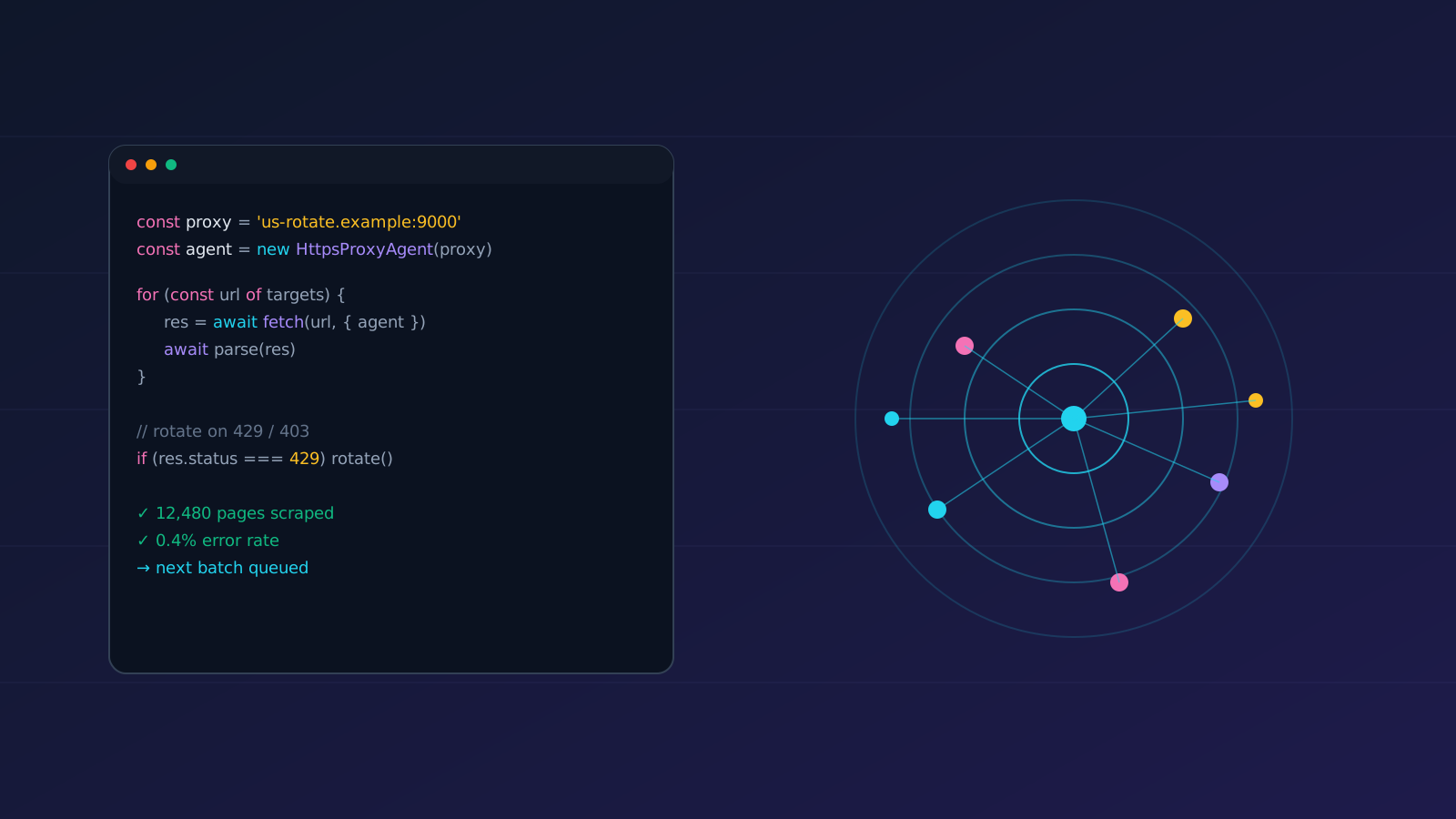
If you are scraping large-scale data from Ahrefs or competitor sites, you cannot rely on a single IP. Proxy rotation is the process of switching your IP address for every new task. Most premium providers offer a "rotating port" where the backend infrastructure handles the switch. For example, if you connect to gate.proxyprovider.com:7000, the provider gives you a new residential IP every time you open a connection.
This ensures that your scraping pattern doesn't develop a predictable footprint. When combined with randomized time.sleep() intervals, your bot becomes nearly indistinguishable from a group of different users accessing the site from various locations. For those looking for vetted IP pools, proxytrust.site provides detailed reviews on which providers offer the cleanest IP blocks.
Common Obstacles and How to Fix Them
Even with the best proxies, you will encounter errors. Understanding these status codes is key to maintaining your scraper:
- 403 Forbidden: This usually means your proxy IP is already blacklisted or your headers are inconsistent. Switch to a residential IP.
- 407 Proxy Authentication Required: Your username/password is wrong, or your server IP isn't whitelisted.
- 429 Too Many Requests: You are moving too fast. Increase the delay between requests or increase the size of your proxy pool.
- 502/504 Gateway Timeout: The proxy node is down or slow. Implement a retry logic in your Python script to catch these exceptions.
Integrating these checks into a robust error-handling loop ensures that one bad IP doesn't crash your entire scraping process. You can find more specialized solutions for these errors at proxyip.top.
Recommended Deals
Looking to scale your scraping operations? Here are the best deals currently available for high-quality proxies:
- 20% Off All Residential Proxies — Save on massive, high-reputation IP pools for undetectable scraping.
- 15% Off Oxylabs Datacenter Plans — Get enterprise-grade speed and reliability for bulk data collection.
FAQ
How do I check if my proxy is working in Selenium?
You can navigate to a site like https://httpbin.org/ip or https://api.ipify.org?format=json. Extract the text from the page body and compare it to your expected proxy IP. If they match, your Selenium instance is successfully routing traffic through the proxy.
Can I use free proxies with Selenium?
We strongly advise against using free proxies for data scraping. Free proxies are often "honeypots" designed to steal data, or they are extremely slow and already blacklisted by major websites. Using them increases the risk of your main accounts or IPs getting flagged.
Is Selenium slow when using residential proxies?
Residential proxies are inherently slower than datacenter proxies because data must travel through a real home internet connection. To mitigate this, use a provider with a large global network, like Smartproxy, which minimizes the hops between the proxy node and the target server.
What is the difference between SOCKS5 and HTTP proxies for Selenium?
HTTP proxies are generally better for web-based scraping as they handle standard web traffic efficiently. SOCKS5 is a lower-level protocol that provides more anonymity and can handle any type of traffic, including UDP, making them ideal for complex applications but sometimes harder to configure with standard Selenium drivers.
Maximizing Your Scraping Success
Mastering the use of proxies with Selenium is a continuous process of adjustment and optimization. By selecting the right provider, like those found on vpsrated.com/proxy, and implementing stealth finger-printing techniques, you can build a scraping engine that bypasses the most advanced perimeter security. Remember to always respect robots.txt where possible and use your scraping power responsibly to avoid overwhelming target servers.
For more budget-friendly options to start your project, check out our full list of proxy coupons to get the best rates on residential, mobile, and datacenter IP addresses.
Get the weekly ProxyPromo brief
Fresh deals, hand-tested codes and honest reviews — every Friday. No spam.