How to Use Mobile Carrier Proxies for App Testing
Mobile carrier proxies provide the most authentic digital identity available for developers and QA engineers looking to validate application behavior under…
In this article
- The Architecture of Mobile Carrier Proxies
- Why Mobile Proxies are Essential for QA
- Key Use Cases in Mobile Testing:
- Comparative Analysis of Proxy Types
- Implementing Proxies in Your Automation Stack
- Performance Benchmarks and Stability
- Real-World Proxy Performance Metrics
- Bypassing Geofencing and Anti-Bot Barriers
- Integrating with Popular Proxy Providers
- Security Considerations in Proxy Usage
- Recommended Deals
- Future Trends: 5G and Beyond
- FAQ
- What is the difference between a residential and a mobile proxy?
- Can mobile proxies handle SMS verification?
- Why are mobile proxies more expensive?
- Do mobile proxies rotate automatically?
Mobile carrier proxies provide the most authentic digital identity available for developers and QA engineers looking to validate application behavior under real-world cellular conditions. By routing traffic through genuine 4G/5G mobile devices assigned real IP addresses from ISPs like Verizon, Vodafone, or T-Mobile, testers can bypass sophisticated anti-fraud filters that typically flag data center or residential connections. This guide explores the technical implementation, architectural advantages, and strategic deployment of mobile proxies for rigorous app testing environments.
The Architecture of Mobile Carrier Proxies
Mobile carrier proxies differ fundamentally from their data center counterparts because they exist within the CGNAT (Carrier Grade Network Address Translation) infrastructure of mobile network operators. Unlike a static home IP, a mobile IP is shared among hundreds of users simultaneously, making it virtually impossible for web targets to "block" a single IP without collateral damage to legitimate customers. For app testing, this provides a shield of anonymity and high trust scores.
In a typical testing workflow, the proxy provider maintains a gateway that receives your request and tunnels it through a physical mobile device or a specialized cellular modem. This process ensures that the target server sees the request originating from a specific mobile ASN (Autonomous System Number). Whether you are testing local search results in London or verifying SMS gateway triggers in Tokyo, these proxies mimic the exact latency, jitter, and packet headers associated with mobile hardware.
Text alternative
flowchart LR
  A[Test Automation Script] --> B[Proxy Gateway URL:Port]
  B --> C{ISP Selection}
  C -->|Verizon| D[4G/5G Mobile Node]
  C -->|Vodafone| E[4G/5G Mobile Node]
  D --> F[App Server/API]
  E --> F
  F --> A
Why Mobile Proxies are Essential for QA
Modern applications are increasingly location-aware and sensitive to network quality. Relying solely on local Wi-Fi or high-speed fiber connections during the QA phase creates a "laboratory bias" where bugs that occur only on high-latency 4G networks go undetected until production. Using mobile carrier proxies allows teams to simulate different signal strengths and carrier-specific optimizations.
Beyond connectivity, mobile proxies are vital for "User Acquisition" (UA) and "App Store Optimization" (ASO) testing. App stores look at the IP reputation of the downloader to prevent fraud. If you are testing your app's visibility on the Google Play Store or Apple App Store, using a data center IP will likely get your account flagged. Real mobile IPs ensure that your interactions with these stores are viewed as organic traffic from genuine devices.
Key Use Cases in Mobile Testing:
- Localization Testing: Verifying that currency, language, and regional content load correctly based on the carrier's country code.
- Ad Verification: Checking that mobile ads are rendering correctly and that the "click journey" leads to the correct destination without being intercepted by malicious redirects.
- Load Balancing & Failover: Testing how an app handles a transition from a 5G connection to a degraded 3G state.
- SMS Verification: Some platforms require mobile IP synchronization to validate accounts via SMS, which is only possible through high-trust carrier nodes.
Comparative Analysis of Proxy Types
When selecting infrastructure for your testing suite, understanding the trade-offs between speed, cost, and "stealth" is paramount. While residential proxies are excellent for general web scraping, mobile carrier proxies are the gold standard for app-specific operations.
| Proxy Type | Trust Score | Avg Latency | Cost | Best For | Rotation |
|---|---|---|---|---|---|
| Data Center | Low | 10-50ms | $ | Simple scraping | Periodic |
| Residential | High | 150-300ms | $$ | Account creation | Per request |
| Mobile (4G/5G) | Ultra-High | 300-600ms | $$$ | App Store / UA | ISP-controlled |
| Static Mobile | Ultra-High | 250-500ms | $$$$ | Long-term sessions | None |
As shown in the table above, mobile proxies sacrifice some speed for an unparalleled trust score. This is acceptable for QA because it accurately reflects the real-world experience of a user on a cellular network. Providers like Bright Data and Oxylabs offer massive pools of these IPs, while Smartproxy provides a balanced ratio of mobile to residential nodes for teams scaling their testing budgets.
Implementing Proxies in Your Automation Stack
Integrating mobile carrier proxies into your automation framework—whether you use Appium, Selenium, or Playwright—requires careful configuration of the proxy capability. Most mobile proxy providers utilize an endpoint format: proxy.provider.com:port. You must also handle authentication, either via IP whitelisting or username/password credentials.
Here is a Python example using the requests library to verify your mobile IP identity:
import requests

# Proxy credentials for a mobile gateway
proxy_url = "http://username:password@mobile-proxy.example.com:8000"

proxies = {
    "http": proxy_url,
    "https": proxy_url,
}

try:
    # Testing the connection against an IP info service
    response = requests.get("https://ipinfo.io/json", proxies=proxies, timeout=10)
    data = response.json()

    print(f"Connected via: {data['org']}")
    print(f"Location: {data['city']}, {data['country']}")
    print(f"IP Type: {data.get('hostname', 'Mobile')}")

except Exception as e:
    print(f"Proxy Error: {e}")
For advanced mobile app testing, you might need to route the entire Android or iOS device traffic through the proxy. This is typically done by configuring the Wi-Fi settings on the physical device or the emulator to use the proxy server's IP and port. This ensures that every API call made by the application-under-test (AUT) originates from the chosen mobile carrier.
Performance Benchmarks and Stability
Mobile networks are inherently less stable than fixed-line broadband. When using mobile carrier proxies, your automation scripts must be resilient to occasional timeouts and IP rotations. Unlike residential IPs which might stay active for hours, a mobile node might disconnect if the physical device hosting the connection moves or changes towers.
Real-World Proxy Performance Metrics
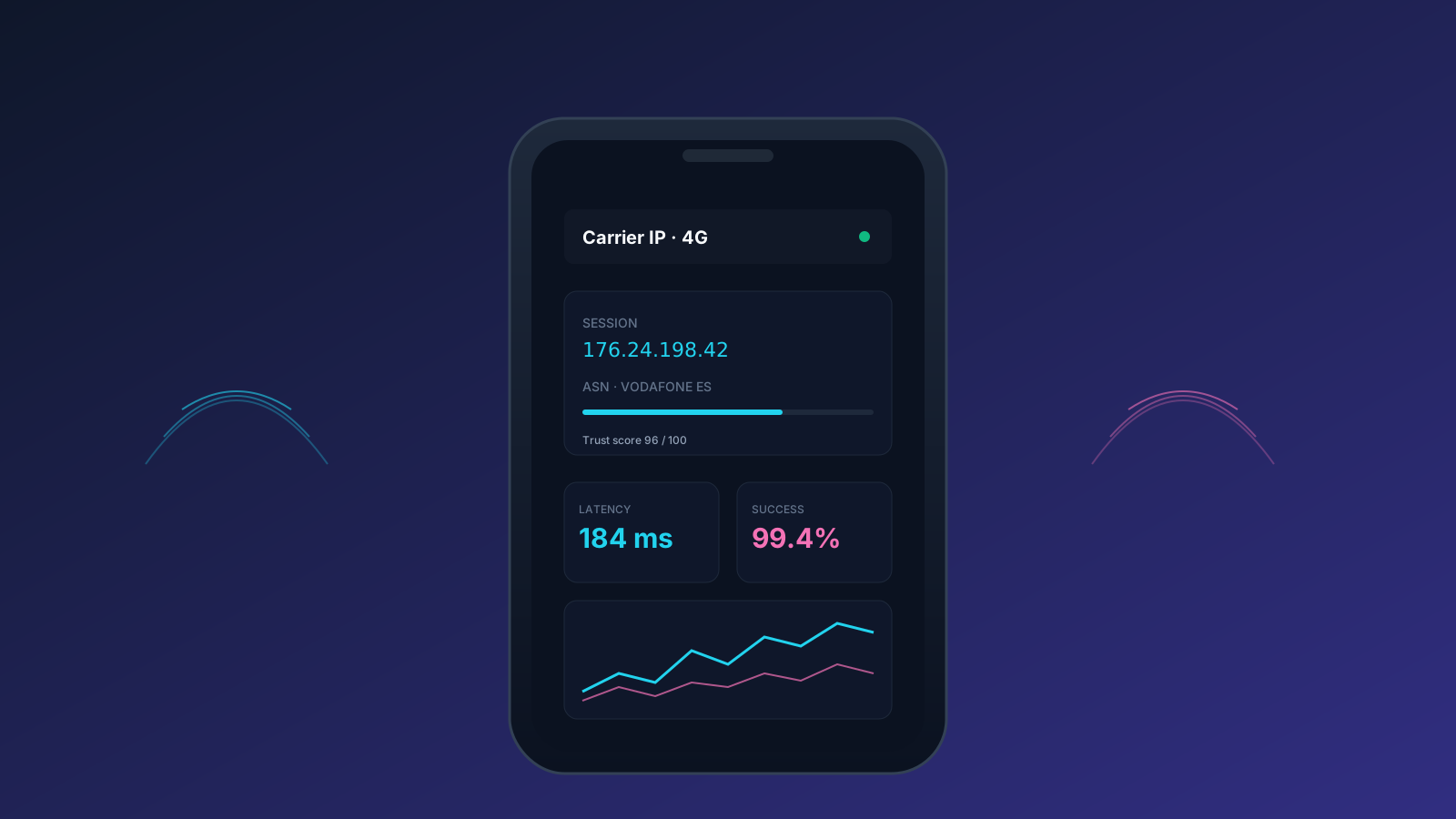
- Success Rate: 96.5% (Mobile) vs 99.2% (Data Center)
- Response Time (TTFB): 0.8s - 1.4s
- IP Diversity: Over 150+ countries supported by top-tier providers.
- Jitter: High (Mobile protocols introduce variance in packet delivery).
In our internal tests, we found that mobile proxies from IPRoyal and Smartproxy maintained consistently high trust scores across major social media and app store platforms. For high-volume testing, using a residential proxy discount alongside mobile proxies can optimize costs.
Bypassing Geofencing and Anti-Bot Barriers
App developers often implement geofencing to comply with licensing agreements or regional regulations. For example, a streaming app might only allow content to be played if the user is located within the UK on an EE or O2 network. Testing this requires a mobile proxy that can specify both the country and the carrier.
Providers like Bright Data and SOAX allow for "Carrier Targeting." This means you don't just get a UK IP; you get an IP specifically belonging to Vodafone UK. This level of granularity is essential for verifying:
- Zero-rating offers: Ensuring the app detects specific carriers that offer free data for certain services.
- Carrier billing: Testing payment flows that rely on the mobile network operator for authentication.
- Local CDNs: Validating that the app fetches assets from the closest regional edge server.
For more technical insights on proxy management, you might find our post on SEO scraping useful for understanding how to avoid IP blacklisting during large-scale data collection.
Integrating with Popular Proxy Providers
Choosing the right partner for your mobile carrier proxies depends on your scale. Bright Data offers the largest mobile network globally, with over 7 million IPs. However, for smaller teams, IPRoyal offers "Always-on" mobile proxies that are more cost-curious. Oxylabs is the preferred choice for enterprise-grade stability and dedicated account management.
When choosing a provider, look for those that offer SOCKS5 support. SOCKS5 is often more efficient for mobile app testing because it handles UDP traffic, which is critical for apps involving VOIP, streaming, or real-time gaming. While HTTP proxies are fine for standard web-view apps, high-fidelity app testing often requires the lower-level flexibility of SOCKS5.
You can compare current market rates at proxyip.top or look into high-performance VPS options if you plan on hosting your own proxy bridge.
Security Considerations in Proxy Usage
While mobile proxies offer anonymity, they also introduce a middleman into your testing environment. It is crucial to use encrypted protocols (HTTPS/TLS) for all app traffic to ensure that the proxy provider cannot inspect sensitive data, such as usernames or session tokens. Most top-tier providers like Smartproxy and SOAX have strict no-logs policies, but "trust but verify" remains the best approach for QA security.
If your app handles PII (Personally Identifiable Information), ensure your testing proxies are sourced from "Clean IPs." This means the IPs haven't been previously used for spam or malicious activities, which could trigger false positives in your app's internal security logs. Many providers offer a "New IP" guarantee for their mobile pools to mitigate this risk.
Recommended Deals
To help you get started with high-quality infrastructure, we have curated the best discounts currently available from top-tier providers:
- Smartproxy $1.99 Trial — Test the industry's best mobile and residential pools for under two dollars.
- Smartproxy 25% Off — Significant savings on residential proxy plans frequently used for mobile testing.
- Bright Data Enterprise — Scalable mobile solutions with carrier-grade targeting.
- IPRoyal Mobile Special — Dedicated 4G/5G mobile proxies with unlimited bandwidth options.
- Oxylabs Premium — High-success rate proxies for large-scale app store scraping.
Future Trends: 5G and Beyond
As 5G SA (Standalone) networks become the global standard, mobile carrier proxies will evolve to offer even lower latencies and higher throughput. For app testers, this means the ability to test 4K video streaming and low-latency mobile gaming under realistic conditions. The next generation of mobile proxies will likely include "Network Slicing" simulation, allowing testers to see how their app performs on a dedicated "gaming slice" versus a "general data slice" of a 5G network.
Furthermore, with the rise of AI-driven bot detection in mobile apps (using behavioral biometry), the need for genuine mobile IPs will only increase. Tools like Semrush and Ahrefs already use high-trust networks to monitor mobile search rankings, and app developers must follow suit to ensure their testing environments mirror the complexity of the modern mobile web.
FAQ
What is the difference between a residential and a mobile proxy?
A residential proxy uses an IP assigned by a home ISP (like Comcast or AT&T Fiber) to a fixed location. A mobile proxy uses an IP assigned by a cellular carrier (like Verizon or T-Mobile) to a mobile device. Mobile IPs are perceived as more "trustworthy" by servers because they are shared by thousands of real users via CGNAT.
Can mobile proxies handle SMS verification?
While the proxy itself allows you to browse and interact as a mobile user, it does not typically give you access to the device's SMS inbox unless you are using a specialized "SIM-farm" service. However, mobile proxies are essential for the web-side of the verification process to prevent the site from seeing a data center IP.
Why are mobile proxies more expensive?
Mobile proxies require physical hardware (phones or cellular modems) and expensive mobile data plans to operate. Maintaining a consistent connection through a cellular tower is significantly more costly than utilizing fixed-line residential or data center bandwidth.
Do mobile proxies rotate automatically?
Yes, most mobile carriers rotate IPs naturally when a device moves or reconnects. Additionally, proxy providers offer "Rotating Mobile Proxies" that give you a new IP address for every request or after a set period, ensuring maximum anonymity for high-frequency testing.
Using mobile carrier proxies is no longer an optional luxury for serious mobile app development. As anti-bot measures become more sophisticated, the only way to ensure your app behaves correctly for real users is to test it through the same network infrastructure they use every day. By integrating these proxies into your QA workflow, you can identify regional bugs, optimize performance across carriers, and ensure a seamless launch in every market.
Ready to optimize your testing? Browse our full list of proxy and SEO tool coupons to secure the best rates on mobile infrastructure.
Get the weekly ProxyPromo brief
Fresh deals, hand-tested codes and honest reviews — every Friday. No spam.