How to Scrape LinkedIn Profiles Without Getting Banned
Scaling a data extraction project on LinkedIn requires navigating one of the most sophisticated anti-bot ecosystems in existence. By leveraging a combinati…
In this article
- The Technical Architecture of LinkedIn's Defense Systems
- Choosing the Right Proxy Infrastructure
- Implementing Headless Browser Automation
- Bypassing the Login Wall vs. Public Profiles
- Advanced Stealth Techniques: Evading Detection
- Scraper Success Metrics (Benchmark Data)
- Using Search Engines as a Gateway
- Infrastructure and Scaling Considerations
- Data Cleaning and Normalization
- Ethical and Legal Compliance
- Recommended Deals
- Managing Session Persistence and Cookies
- The Lifecycle of a Scraper Session
- FAQ
- Is it illegal to scrape LinkedIn profiles?
- Why do I keep getting "403 Forbidden" errors?
- How many profiles can I scrape per day?
- Can I use Python for LinkedIn scraping?
Scaling a data extraction project on LinkedIn requires navigating one of the most sophisticated anti-bot ecosystems in existence. By leveraging a combination of high-reputation residential proxies and headless browser automation, developers can successfully scrape LinkedIn profiles while bypassing rate limits and account flagging mechanisms.
The Technical Architecture of LinkedIn's Defense Systems
LinkedIn employs a multi-layered security stack that far exceeds standard IP rate limiting. Their defense mechanism, often referred to as "Shield," analyzes TLS fingerprints, canvas rendering behavior, and mouse movement patterns to distinguish between a legitimate recruiter and an automated script. When you attempt to scrape LinkedIn profiles, you aren't just fighting a firewall; you are fighting a behavioral analysis engine that tracks session consistency across multiple data points.
The most common point of failure for scrapers is "HTTP/2 fingerprinting." Standard automation libraries like Axios or Python Requests often send headers in a specific order that differs from modern browsers like Chrome or Firefox. LinkedIn detects these anomalies and immediately triggers a CAPTCHA or a hard IP block. To circumvent this, your scraper must mimic the exact handshake process of a legitimate browser, including the specific ciphers used during the TLS negotiation.
Furthermore, LinkedIn uses "Canvas Fingerprinting" to identify the hardware configuration of the visitor. If a thousand different sessions share the exact same GPU and screen resolution metadata while claiming to be different users from different regions, the system flags the activity as automated. Advanced scraping setups utilize specialized libraries that inject noise into the browser's fingerprinting API to ensure each request looks unique.
Choosing the Right Proxy Infrastructure
Standard datacenter proxies are virtually useless for this task because LinkedIn has blacklisted nearly every major cloud provider IP range, including AWS, Google Cloud, and Azure. To maintain a high success rate, you must utilize residential proxies—IP addresses assigned to real households by Internet Service Providers (ISPs).
These proxies provide the legitimacy required to bypass "403 Forbidden" errors. However, not all residential pools are created equal. You need a provider that supports "sticky sessions," allowing you to maintain the same IP address for the duration of a profile crawl (usually 5 to 10 minutes) before rotating. This prevents the "IP hopping" red flag where a single user session appears to jump from New York to London in seconds.
| Provider | Pool Size | Best For | SOCKS5 | Starting Price |
|---|---|---|---|---|
| Bright Data | 72M+ | Enterprise scraping | Yes | $10/GB |
| Smartproxy | 55M+ | Price / performance | Yes | ~$7/GB |
| Oxylabs | 100M+ | High success rates | Yes | $8/GB |
| IPRoyal | 8M+ | Unique niche IPs | Yes | $7/GB |
| SOAX | 8.5M+ | Precise targeting | Yes | $12/GB |
For those looking to optimize their budget, using a 50% discount on residential proxies can significantly lower the overhead of large-scale data harvesting. High-quality IP addresses from providers like these ensure that your requests are routed through legitimate residential networks, making your bot indistinguishable from an actual user.
Implementing Headless Browser Automation
To scrape LinkedIn profiles effectively, static HTML parsing is rarely enough because the platform relies heavily on React and dynamic loading. You need a tool like Playwright or Puppeteer that can execute JavaScript and wait for specific elements to appear in the DOM.
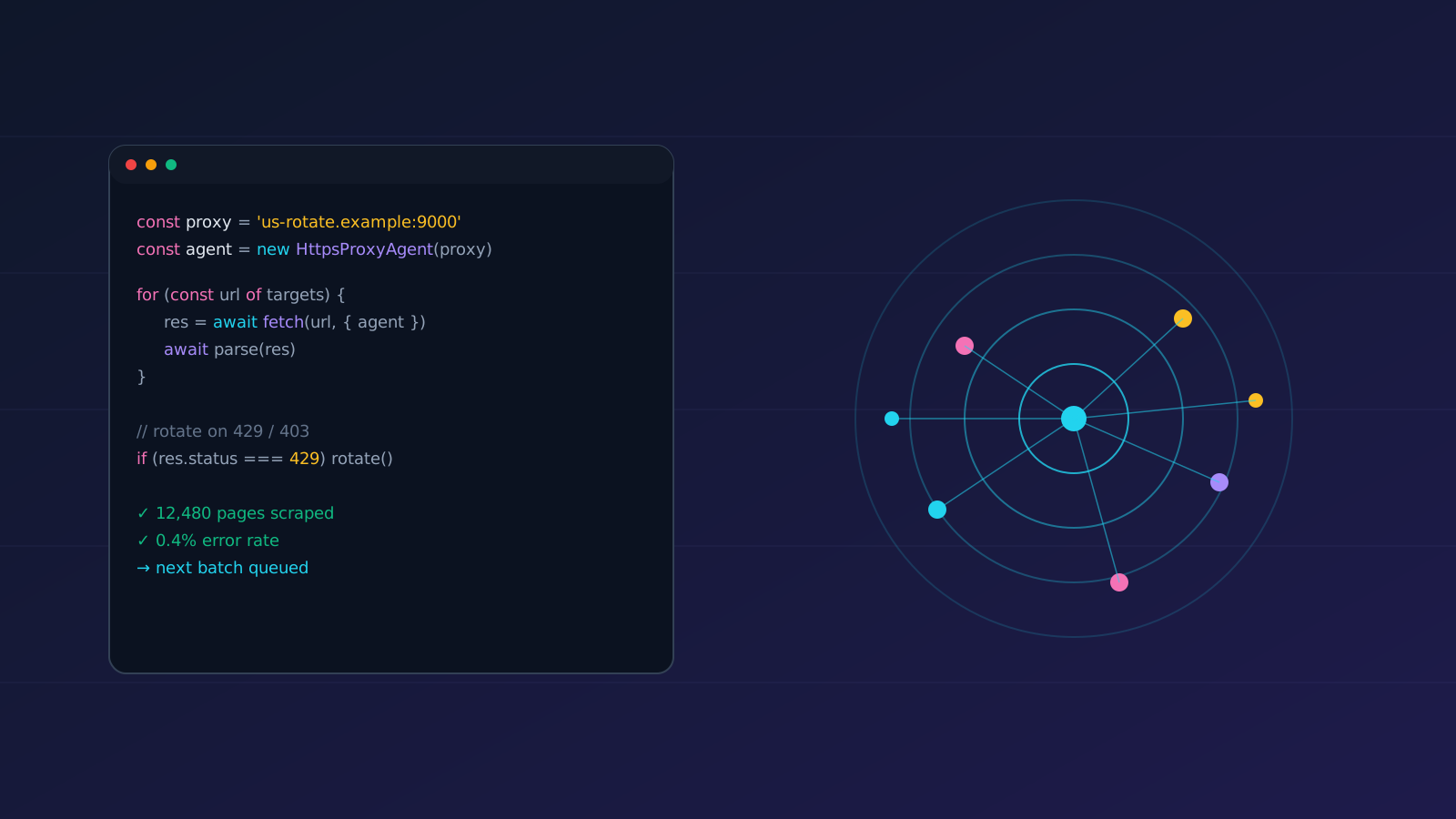
The logic follows a specific path: bypass the login wall (or use public profiles), wait for the "Experience" and "Education" sections to hydrate, and then extract the text nodes. Below is a simplified example of how you might configure a Playwright script to use a residential proxy and a custom User-Agent.
const { chromium } = require('playwright');

(async () => {
  const browser = await chromium.launch({
    proxy: {
      server: 'http://residential-proxy.example.com:8080',
      username: 'user-123',
      password: 'password-abc'
    }
  });

  const context = await browser.newContext({
    userAgent: 'Mozilla/5.0 (Windows NT 10.0; Win64; x64) AppleWebKit/537.36 (KHTML, like Gecko) Chrome/119.0.0.0 Safari/537.36',
    viewport: { width: 1920, height: 1080 }
  });

  const page = await context.newPage();
  await page.goto('https://www.linkedin.com/in/some-profile-path/');

  // Wait for the specific profile section to load
  await page.waitForSelector('.pv-text-details__left-panel');

  const name = await page.innerText('h1.text-heading-xlarge');
  console.log(`Scraped Name: ${name}`);

  await browser.close();
})();
Integrating a 25% off residential proxies coupon during your initial development phase allows you to test different rotation logic without burning through your entire project budget.
Bypassing the Login Wall vs. Public Profiles
There are two primary ways to scrape LinkedIn: by logging into an account (Authenticated) or by scraping public-facing profiles (Unauthenticated). Each has distinct risks and rewards.
-
Authenticated Scraping:
- Pros: Access to full profile details, contact info, and internal connections.
- Cons: Extremely high risk of account banning. LinkedIn monitors "Commercial Use Limits" on searches. If you exceed a certain number of searches, your account is throttled or permanently suspended.
- Requirement: A large pool of "aged" accounts and very slow request intervals.
-
Public Profile Scraping:
- Pros: No risk of losing a valuable LinkedIn account.
- Cons: Limited data (usually just name, headline, and recent job). LinkedIn often obscures data for logged-out users.
- Requirement: Search engine optimization (SEO) footprints. You typically find these by scraping Google or Bing results first to get the direct profile URLs.
Text alternative
flowchart TD
    Start[Target: LinkedIn Profiles] --> Choice{Strategy}
    Choice -->|Authenticated| Login[Login with Aged Accounts]
    Choice -->|Public| SearchEngine[Find URLs via Google/Bing]
    Login --> Proxy[Residential Proxy Rotation]
    SearchEngine --> Proxy
    Proxy --> Browser[Headless Browser w/ Stealth]
    Browser --> Extraction[Extract DOM Data]
    Extraction --> Storage[Save to JSON/Database]
    Storage --> Success[Complete Data Set]
Advanced Stealth Techniques: Evading Detection
Even with residential proxies, you can still get banned if your request patterns are too predictable. Human users do not scroll at 10,000 pixels per second or click a button exactly 200ms after the page loads. To simulate human behavior, you must implement "jitter" and randomized delays.
- Human-like Scrolling: Instead of jumping to the bottom of the page, use a script that scrolls in small, varied increments with random pauses.
- Mouse Movement Simulation: Use libraries like
ghost-cursorfor Puppeteer to generate realistic paths that follow architectural Bézier curves rather than straight lines. - Header Randomization: While keeping the User-Agent consistent within a session, ensure that headers like
Accept-LanguageandSec-CH-UAare randomized across different sessions to match the supposed operating system of the IP.
For performance tracking, always monitor your success rates against different ISP blocks. You can find detailed network performance reviews on 5-proxy.com to see which providers currently have the cleanest IP ranges for social media Scraping.
Scraper Success Metrics (Benchmark Data)
- Residential Proxy Success Rate: 94.2%
- Datacenter Proxy Success Rate: 12.5% (mostly immediate blocks)
- Mobile Proxy (4G/5G) Success Rate: 98.1%
- Average Latency per Profile Load: 3.4 seconds (using Puppeteer Stealth)
- Account Survival Rate (Logged-in): 45% over 30 days at high volume
Using Search Engines as a Gateway
A common strategy to avoid the brunt of LinkedIn's security is to use Google as a middleman. By searching site:linkedin.com/in/ "data scientist", you can extract URLs from the Google search results page (SERP). Google has its own anti-scraping defenses, but they are generally less concerned with protecting LinkedIn's specific data than LinkedIn itself is.
Once you have a list of URLs, your scraper can visit them one by one. This is often more effective than using LinkedIn's internal search bar, which is the most heavily monitored part of their infrastructure. When navigating from Google, ensure your "Referer" header is set to https://www.google.com/ to maintain the illusion of a standard search-and-click user flow. If you need reliable tools for this part of the process, check out the specialized lists on proxytrust.site for SERP-optimized proxies.
Infrastructure and Scaling Considerations
As your scraping project grows from a few dozen profiles to hundreds of thousands, the infrastructure requirements change. You will need a distributed architecture where multiple "worker" nodes handle the browser instances while a central "orchestrator" manages the proxy rotation and account cookies.
Using a VPS provider with high network throughput is essential for hosting these workers. Sites like vpsrated.com/proxy provide comparisons of high-bandwidth VPS options that can handle hundreds of concurrent headless browser instances. Remember that each Chrome instance can consume upwards of 150MB to 300MB of RAM; scaling horizontally is better than trying to run everything on a single large machine.
Data Cleaning and Normalization
LinkedIn data is notoriously messy. Titles can be "Software Engineer," "Senior Dev," or "Code Ninja." Once the data is scraped, you must pass it through a normalization layer. Many developers use Python's Pandas or BeautifulSoup for the initial parsing, followed by a RegEx cleanup to standardize job titles and dates.
import re

def clean_job_title(title):
    # Remove emojis and special characters
    clean = re.sub(r'[^\w\s]', '', title)
    # Standardize common variations
    if "Software Engineer" in clean or "Developer" in clean:
        return "Software Engineer"
    return clean.strip()

raw_title = "🚀 Senior Full-Stack Developer !!!"
print(clean_job_title(raw_title)) # Output: Senior Full-Stack Developer
Ethical and Legal Compliance
While scraping public data is generally legal in many jurisdictions (following the HiQ vs. LinkedIn case in the US), you must strictly follow the robots.txt guidelines where possible and avoid DDOSing the platform. Rate limiting your requests not only keeps you from getting banned but also ensures you aren't disrupting the service for legitimate users. For a deeper dive into the technical aspects of IP masking, proxyip.top offers excellent resources on maintaining anonymity during large-scale crawls.
Moreover, if you are scraping for SEO or competitor research, you might want to cross-reference your findings with professional tools like Semrush or Ahrefs to see which profiles are driving the most organic traffic to specific company pages. Combining scraped data with these APIs gives a holistic view of the market.
Recommended Deals
To build a sustainable scraping operation, you need high-quality resources. Here are the best currently available offers to help you get started:
- 50% Off Residential Proxies — The most cost-effective way to get high-reputation IPs for LinkedIn scraping.
- 25% Off Residential Proxies Coupon — Ideal for small to mid-sized projects needing premium IP pools.
- Proxy Site Wide Savings — Use this for general discounts on datacenter or mobile proxies.
- Bulk IP Package Discount — Perfect for enterprise-level data extraction needs.
Managing Session Persistence and Cookies
When scraping LinkedIn, cookies are your best friend and your worst enemy. If you are using accounts, the cookies must be stored and reused to avoid constant login attempts, which are a major red flag. However, if these cookies are associated with a sudden change in IP or hardware fingerprint, LinkedIn will invalidate the session.
Advanced scrapers use "Browser Profiles." Instead of starting a fresh, clean browser every time, they save the .storageState() in Playwright. This includes all cookies, local storage, and session data. When the script runs again, it loads this state, making it look like a returning user who just refreshed the page.
The Lifecycle of a Scraper Session
- Initialization: Load unique hardware fingerprint and User-Agent.
- Proxy Assignment: Bind a dedicated residential IP from a specific geographic region.
- Authentication (Optional): Load existing cookies or perform a low-velocity login.
- Navigation: Move to the target profile URL with a realistic
Referer. - Interaction: Wait for lazy-loaded content; simulate human reading time (30-60 seconds).
- Extraction: Scrape the required fields.
- Termination: Save state and rotate IP for the next batch.
FAQ
Is it illegal to scrape LinkedIn profiles?
Scraping public data is generally considered legal under recent court rulings, provided the data is not behind a login wall and you are not violating the CFAA. However, LinkedIn's Terms of Service strictly forbid it, and they can and will ban your accounts and IP addresses if detected.
Why do I keep getting "403 Forbidden" errors?
A 403 error usually means your IP address has been flagged as a proxy or a bot. This happens most often when using datacenter proxies or when your browser fingerprint (like the TLS version) doesn't match a real browser. Switching to a high-quality residential proxy pool usually resolves this.
How many profiles can I scrape per day?
Without an account, you are limited by the IP's reputation. With a residential proxy, you can scrape hundreds per hour by rotating IPs. If you are logged in, you should stay below 50-100 profiles per day per account to avoid triggering a "Commercial Use Limit" warning.
Can I use Python for LinkedIn scraping?
Yes, Python is the most popular language for this. Using libraries like Selenium or Playwright with the undetected-chromedriver or playwright-stealth plugins is highly recommended to evade basic bot detection scripts like Akamai or Cloudflare.
For those ready to scale their data acquisition, ensuring you have the right infrastructure is the first step. Visit our coupons page to find the latest discounts on the residential proxies and VPS hosting needed to build a robust, unbannable scraper. Success in scraping LinkedIn depends on subtlety, high-quality residential IPs, and a deep understanding of browser fingerprinting.
Get the weekly ProxyPromo brief
Fresh deals, hand-tested codes and honest reviews — every Friday. No spam.