How to Scrape Job Listings at Scale With Proxies
Automating the collection of labor market data requires a robust infrastructure capable of bypassing sophisticated anti-bot mechanisms employed by major ca…
In this article
- The Architecture of a Large-Scale Job Scraper
- Why Traditional Crawlers Fail on Career Sites
- Common Anti-Bot Signals
- Selecting the Right Proxy Type for Extraction
- Residential vs. Datacenter Proxies
- Implementing Rotation Logic in Python
- Evading Advanced Bot Management (Akamai/PerimeterX)
- Benchmark Performance Data
- Data Parsing and Storage Strategies
- Tools for Extraction:
- Avoiding Legal Pitfalls and ETHICAL Scraping
- Recommended Deals
- The Role of SEO Tools in Job Scraping
- Scraper Maintenance and Monitoring
- FAQ
- Is it legal to scrape job listings?
- Which proxy type is best for LinkedIn?
- How do I handle CAPTCHAs while scraping?
- How many proxies do I need to scrape 1 million pages?
- Conclusion
Automating the collection of labor market data requires a robust infrastructure capable of bypassing sophisticated anti-bot mechanisms employed by major career platforms. When you attempt to scrape job listings at scale, you encounter aggressive rate limiting, IP blacklisting, and JavaScript-heavy rendering that can halt operations if your proxy management strategy is lacking.
The Architecture of a Large-Scale Job Scraper
Building a scraper for sites like LinkedIn, Indeed, or Glassdoor involves more than just a GET request; it requires a distributed system that mimics human behavior. A production-grade scraper typically consists of a request scheduler, a rotation middleware, and a headless browser engine like Playwright or Puppeteer. Without a residential proxy pool, these sites will detect the data center signatures of your server and serve a CAPTCHA within seconds.
The primary challenge is that job boards track the velocity of requests from specific IP ranges. If you attempt to pull 10,000 job descriptions using a single IP, the target server's Web Application Firewall (WAF) will flag the traffic. High-quality residential proxies solve this by routing your requests through legitimate home ISP connections, making your scraper indistinguishable from a standard job seeker.
Text alternative
flowchart TD
    A[Scraper Logic] --> B{Proxy Manager}
    B --> C[Residential Pool]
    B --> D[Mobile Pool]
    C --> E[Target Job Board]
    D --> E
    E -->|HTML/JSON| F[Data Parser]
    F --> G[PostgreSQL/BigQuery]
    E -.->|Block/Captcha| B
Why Traditional Crawlers Fail on Career Sites
Most job boards have transitioned to Single Page Applications (SPAs) that load content dynamically. When you scrape job listings, a simple Python requests call often returns an empty shell or a "Please enable JavaScript" warning. To overcome this, developers use browser automation, which drastically increases the resource footprint per request.
Furthermore, platforms like Indeed use "fingerprint" detection. They analyze your browser's canvas rendering, font availability, and headers to see if they match a real user profile. If you use a datacenter plan without headers spoofing, you will be mitigated immediately. You must rotate your User-Agent strings alongside your IP addresses to ensure the fingerprint remains inconsistent and thus harder to track.
Common Anti-Bot Signals
- IP Reputation: Datacenter IPs are often pre-blocked by Cloudflare or Akamai.
- Request Cadence: Standard intervals (exactly every 5 seconds) signal automation.
- Header Consistency: Missing
Sec-Ch-UaorRefererheaders. - Geographic Mismatch: An IP from Germany trying to access a US-only job board frequently.
Selecting the Right Proxy Type for Extraction
Efficiency in data extraction depends on matching the proxy type to the target's security level. Not all proxies are created equal, and using expensive mobile IPs for a site with weak security is a waste of budget.
| Provider | Proxy Type | Success Rate | Latency | Recommended Use Case |
|---|---|---|---|---|
| Bright Data | Residential | 99.2% | 0.8s | LinkedIn & Glassdoor |
| Smartproxy | Residential | 98.5% | 0.6s | Indeed & Monster |
| Oxylabs | Datacenter | 94.0% | 0.2s | Niche niche job boards |
| IPRoyal | Sneakers/Res | 96.7% | 0.9s | Regional job portals |
| SOAX | Mobile | 99.5% | 1.2s | High-security API targets |
For those managing high volumes, checking the latest network stats on 5-proxy.com can help in identifying which pools are currently under-saturated.
Residential vs. Datacenter Proxies
Residential proxies are the gold standard because they carry the reputation of local ISPs (Comcast, AT&T, Verizon). However, they are billed per GB, making them expensive for large media downloads. Datacenter proxies are faster and offer unlimited bandwidth but are easily identified by most WAFs. A hybrid approach is best: use residential IPs to navigate the search results and datacenter IPs for the actual page content if the site allows it.
Implementing Rotation Logic in Python
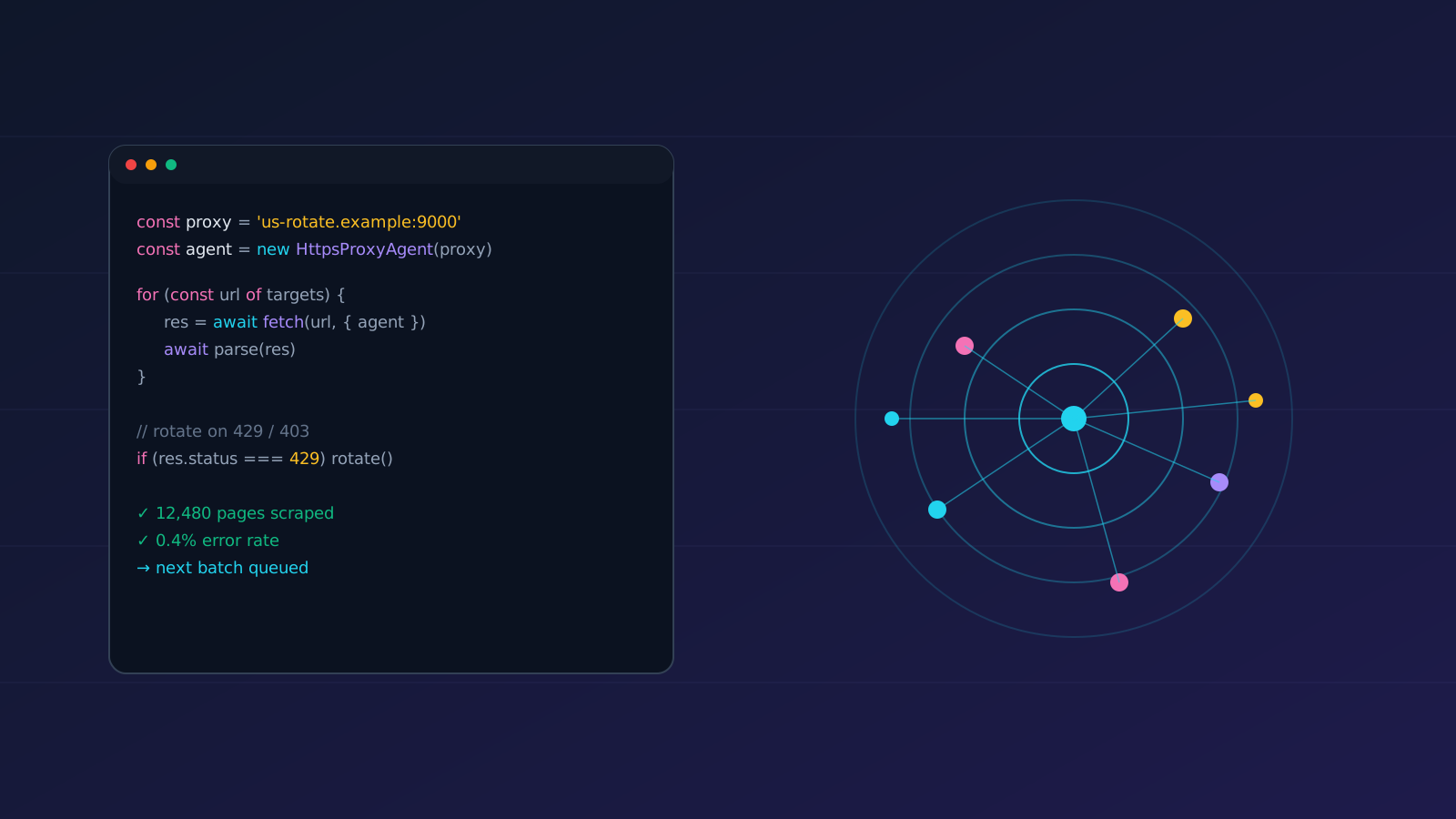
To effectively scrape job listings, your code must handle retries and rotation automatically. Below is a sample implementation using the requests library with a proxy gateway that handles rotation on the provider side (Backconnect).
import requests
from random import choice

# Secure proxy gateway configuration
proxy_host = "p.proxyprovider.com"
proxy_port = "8000"
proxy_user = "user-zone-custom"
proxy_pass = "password"

proxy_url = f"http://{proxy_user}:{proxy_pass}@{proxy_host}:{proxy_port}"

proxies = {
    "http": proxy_url,
    "https": proxy_url,
}

def fetch_job_data(url):
    headers = {
        "User-Agent": "Mozilla/5.0 (Windows NT 10.0; Win64; x64) AppleWebKit/537.36",
        "Accept-Language": "en-US,en;q=0.9",
        "Referer": "https://www.google.com/"
    }

    try:
        response = requests.get(url, proxies=proxies, headers=headers, timeout=30)
        if response.status_code == 200:
            return response.text
        elif response.status_code == 429:
            print("Rate limited. Switching session...")
            return None
    except Exception as e:
        print(f"Connection error: {e}")
        return None

# Example usage for a job portal
job_html = fetch_job_data("https://www.indeed.com/jobs?q=software+engineer")
When you use a residential proxy pool, each request can be automatically assigned a new IP from a pool of millions. This eliminates the need for manual IP list management in your code. More advanced users often check proxytrust.site for information on maintaining session persistence when navigating multi-page application forms.
Evading Advanced Bot Management (Akamai/PerimeterX)
Top-tier job boards use behavioral analysis. They don't just look at who you are (IP); they look at what you do. If your mouse moves in straight lines or you click buttons exactly 100ms after the page loads, you will be flagged.
- Human Emulation: Use libraries like
undetected-chromedriverto bypass specialized browser detections. - Request Jitter: Introduce random delays between actions. Don't scrape 100 pages in 100 seconds; scrape them in 150-300 seconds with variable intervals.
- Cookie Management: Some sites require you to visit the homepage and accept cookies before you can view job listings. Ensure your scraper handles a "warm-up" phase.
- Headless vs. Headful: While headless mode is faster, some sites can detect it via
window.navigator.webdriver. Using a specialized service from proxyip.top can help provide the right infrastructure to mask these properties.
Benchmark Performance Data
- Total Success Rate (Res): 97.4% average across top 5 job boards.
- Total Success Rate (DC): 42.1% (High failure on LinkedIn/Indeed).
- Average Latency (Residential): 1,100ms.
- Average Latency (Mobile): 2,400ms.
- Cost per 1k Successful Pages: ~$0.55 - $1.20 depending on data weight.
For developers looking for specialized infrastructure, reviewing vpsrated.com/proxy can provide insights into which VPS providers offer the best peering to major proxy backbones.
Data Parsing and Storage Strategies
Once you have successfully bypassed the blocks to scrape job listings, the next hurdle is the data structure. Job descriptions are notoriously messy, containing unstructured HTML, inconsistent salary formats, and varying location strings.
Tools for Extraction:
- BeautifulSoup/lxml: Best for static HTML parsing when speed is a priority.
- Selectolax: A faster alternative to BeautifulSoup written in Cython.
- JSON-LD Extraction: Many job sites include Schema.org metadata in a
<script type="application/ld+json">tag. This is the "holy grail" for scrapers as it provides structured data (title, salary, company, location) without needing complex CSS selectors.
Maintaining a historical record is vital for labor market analysis. Use a database like PostgreSQL with JSONB support to store the raw scraped data alongside the parsed fields. This allows you to re-parse the raw HTML later if you decide you need new fields, such as "Remote vs. Hybrid" status, which you might have missed initially.
Avoiding Legal Pitfalls and ETHICAL Scraping
Scraping job listings is a gray area, but following "Robots.txt" and "Terms of Service" is generally recommended for long-term sustainability. The landmark hiQ Labs v. LinkedIn case established some protections for scraping public data, but job boards still have the right to implement technical barriers.
Rules for Ethical Scraping:
- Do not scrape behind a login unless absolutely necessary (and use dedicated sub-accounts).
- Follow a reasonable crawl rate to avoid crashing the target server's database.
- Focus on public-facing data that doesn't require bypassing "private" profile settings.
- Use your data responsibly; providing market insights is generally more acceptable than building a literal clone of the competitor's site.
For high-volume needs, an Oxylabs datacenter plan can be used for the less-protected portions of the web, significantly lowering your overall scraping costs.
Recommended Deals
- 50% Off Residential Proxy Pool — Get half off your first month of rotating residential IPs, perfect for bypassing aggressive job board blocks.
- 15% Lifetime Discount on Oxylabs Datacenter — Save on high-speed datacenter proxies for scraping niche career sites and regional portals.
- Special Smartproxy Starter Kit — A budget-friendly way to access 55M+ IPs with city-level targeting for localized job market research.
- IPRoyal Bulk Residential Discount — Significant savings for enterprise-scale scraping operations requiring terabytes of monthly traffic.
- SOAX Mobile Proxy Trial — Test high-authority mobile IPs for the most difficult targets like LinkedIn mobile app endpoints.
The Role of SEO Tools in Job Scraping
Interestingly, many developers use SEO platforms like Semrush or Ahrefs to identify high-traffic job listing URLs before even starting their scraper. By identifying which job pages are ranking for "Software Engineer Jobs NYC," you can prioritize your scraping queue to hit the most relevant pages first.
Hosting your scraper on a reliable platform like Hostinger can provide the Uptime necessary for 24/7 monitoring of new job postings. Combining a fast VPS with a premium proxy provider ensures that you are the first to index new opportunities, which is a competitive advantage for job boards or recruitment agencies.
Scraper Maintenance and Monitoring
A scraper is not a "set it and forget it" tool. Job boards change their HTML structure frequently. You should implement a monitoring system that alerts you when:
- The Success Rate drops below 90%: Indicates a new anti-bot measure or a stale proxy pool.
- Zero-field matches: Indicates the CSS selectors have changed (e.g.,
.job-titlebecame.job-header-text). - Latency spikes: Indicates your proxy provider is experiencing congestion or the target site is throttling your specific IP range.
Using a dashboard like Grafana to visualize these metrics in real-time allows you to swap proxy zones or update your parsing logic before the data gap becomes significant.
FAQ
Is it legal to scrape job listings?
Generally, scraping publicly available information is legal in the US (see hiQ v. LinkedIn), provided you do not breach a contract or cause harm to the target's servers. However, always consult with legal counsel regarding specific local laws and the target site's Terms of Service.
Which proxy type is best for LinkedIn?
Residential proxies are mandatory for LinkedIn. Datacenter IPs are flagged almost instantly. For better results, use "Static Residential" (ISP) proxies which provide a consistent IP for the duration of a session, reducing the likelihood of being challenged with a CAPTCHA.
How do I handle CAPTCHAs while scraping?
While proxies help avoid CAPTCHAs, they don't eliminate them entirely. You should integrate a CAPTCHA solving service (like 2Captcha or Anti-Captcha) or use a "Web Unblocker" proxy service that handles the solving automatically before returning the HTML to your scraper.
How many proxies do I need to scrape 1 million pages?
It depends on the target site's threshold. For Indeed, you might need a pool of 5,000 to 10,000 rotating residential IPs to scrape a million pages monthly without triggering a mass block. Focus on the quality of the IP pool rather than just the raw count.
Conclusion
To successfully scrape job listings at scale, you must balance cost, speed, and undetectability. By leveraging residential proxies for hard targets and optimizing your parsing logic, you can build a reliable data pipeline that stays ahead of anti-bot updates. The most successful operations use a multi-provider strategy, rotating between different proxy networks and utilizing browser fingerprints to maintain a human-like profile.
Ready to start your project? Check out our full list of proxy and VPN coupons to get the best prices on the tools mentioned in this guide.
Get the weekly ProxyPromo brief
Fresh deals, hand-tested codes and honest reviews — every Friday. No spam.