How to Scrape Google SERPs Without Getting Blocked
Developing a robust pipeline to scrape Google SERPs requires navigating a landscape of sophisticated anti-bot mechanisms, including CAPTCHAs, TLS fingerpri…
In this article
- The Architecture of a Google SERP Scraper
- The Component Stack
- Mastering IP Rotation and Peer-to-Peer Networks
- Handling Advanced Anti-Bot Features
- Real-world Python Implementation
- Scaling with Headless Browsers
- Performance Benchmarks
- Geolocation and Localized Search Results
- Extracting Data from Structured Elements
- Avoiding the "Legal and Ethical" Pitfalls
- Managing Session Persistence and Cookies
- Monitoring and Maintenance: The Scraping Lifecycle
- Recommended Deals
- FAQ
- How many requests can I send to Google per minute?
- Is scraping Google SERPs legal?
- Why am I seeing CAPTCHAs even with residential proxies?
- Can I use free proxies to scrape Google?
Developing a robust pipeline to scrape Google SERPs requires navigating a landscape of sophisticated anti-bot mechanisms, including CAPTCHAs, TLS fingerprinting, and behavioral analysis. Success depends on simulating human-like request patterns through high-quality residential rotation and headless browser orchestration to ensure your data collection remains uninterrupted.
The Architecture of a Google SERP Scraper
Building a scraper for Google Search Result Pages (SERPs) is fundamentally different from scraping a standard e-commerce site. Google employs a multilayered defense system that monitors request frequency, header consistency, and IP reputation. To bypass these hurdles, your architecture must separate the request logic from the data parsing logic, using a middle layer for proxy management.
A resilient scraper typically utilizes a backconnect proxy server. Instead of manually rotating thousands of IPs in your code, you connect to a single entry point provided by a service like those found via 25% off residential proxies, which automatically assigns a new residential IP for every request or session. This prevents Google from seeing multiple requests originating from the same subnetwork, which is a primary trigger for "Unusual Activity" blocks.
The Component Stack
- Request Layer: Utilizes libraries like
PlaywrightorPuppeteerto handle JavaScript execution. - Proxy Layer: Reassigns requests to residential or mobile IPs to mask the data center origin.
- Parsing Layer: Uses
BeautifulSouporCheerioto extract organic results, featured snippets, and "People Also Ask" sections. - Data Storage: Structured output into JSON or CSV for SEO analysis tools.
Text alternative
graph TD
  A[Scraper Script] --> B[Headless Browser]
  B --> C[Proxy Gateway]
  C -->|IP Rotation| D[Google Search]
  D --> E{Success?}
  E -->|Yes| F[Parse HTML]
  E -->|No| G[Retry with New IP]
  F --> H[Save to Database]
Mastering IP Rotation and Peer-to-Peer Networks
The quality of your IP address is the single most important factor when you attempt to scrape Google SERPs. Google maintains a massive database of banned data center IP ranges. If you use a standard VPS IP, you will likely hit a CAPTCHA on the very first request. This is why professional SEOs prefer residential proxies, which are IPs assigned by Internet Service Providers (ISPs) to real homeowners.
When using residential networks, you benefit from high "IP diversity." By spreading your requests across tens of thousands of different geographic locations, you mimic the natural traffic patterns of global users. Organizations often look for 15% off Oxylabs datacenter plans for less sensitive tasks, but for Google organic results, the residential tier remains the gold standard.
| Proxy Type | Detection Risk | Speed | Cost | Best Use Case |
|---|---|---|---|---|
| Residential | Very Low | Moderate | High | Google SERP Scraping |
| Datacenter | High | Very Fast | Low | Pricing Monitoring |
| Mobile (4G/5G) | Minimal | Variable | Highest | App Store Scraping |
| ISP/Static | Low | Fast | Moderate | Social Media Accounts |
Handling Advanced Anti-Bot Features
Google doesn't just look at your IP; it looks at how your browser "speaks" to its servers. This includes TLS (Transport Layer Security) fingerprinting. If your scraper uses the default node-fetch or Python Requests settings, the server can identify that the request is coming from a script rather than a Chrome or Firefox browser.
To mitigate this, you must implement "Stealth" plugins. For example, if you are using Playwright, the playwright-extra package allows you to evade common detection tests like navigator.webdriver checks. Furthermore, you should randomize your user-agent strings. Never use a generic user-agent; instead, rotate between the top 50 most common browser strings currently in use by real users.
Real-world Python Implementation
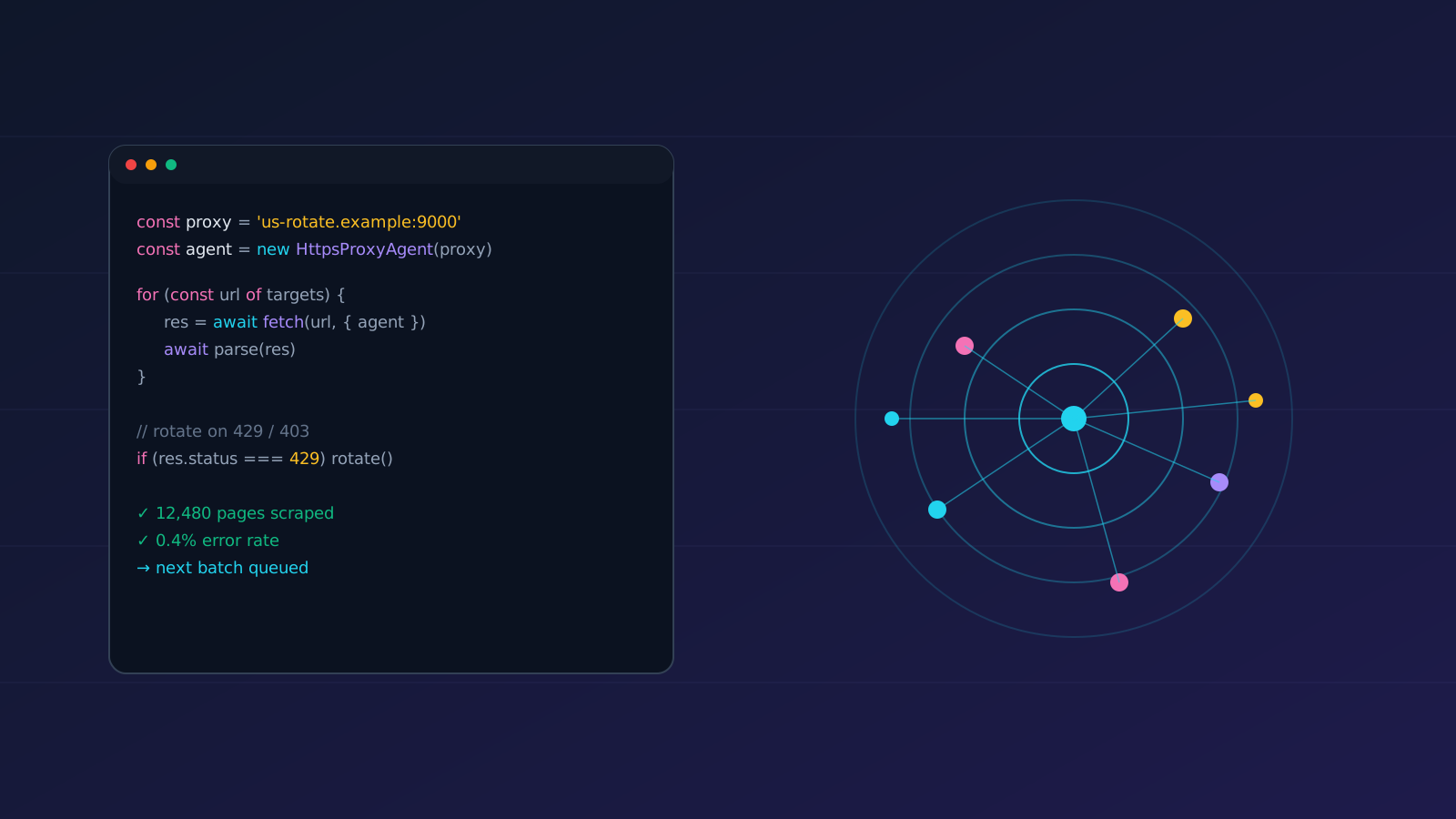
The following snippet demonstrates how to integrate a proxy with a custom user-agent to fetch a Google search result:
import requests

def fetch_google_serp(query, proxy_url):
    headers = {
        'User-Agent': 'Mozilla/5.0 (Windows NT 10.0; Win64; x64) AppleWebKit/537.36 (KHTML, like Gecko) Chrome/119.0.0.0 Safari/537.36',
        'Accept-Language': 'en-US,en;q=0.9',
        'Referer': 'https://www.google.com/'
    }

    proxies = {
        'http': proxy_url,
        'https': proxy_url
    }

    encoded_query = query.replace(' ', '+')
    url = f"https://www.google.com/search?q={encoded_query}&num=100"

    try:
        response = requests.get(url, headers=headers, proxies=proxies, timeout=10)
        if response.status_code == 200:
            return response.text
        else:
            print(f"Error: Status code {response.status_code}")
    except Exception as e:
        print(f"Request failed: {e}")

# Example usage with a residential proxy entry point
# fetch_google_serp("best seo tools 2024", "http://user:pass@p.proxyprovider.com:8000")
Scaling with Headless Browsers
While requests is fast, many Google SERP features (like the maps pack or interactive snippets) require JavaScript to render fully. In these cases,
headless browsers are mandatory. Tools like Puppeteer and Playwright navigate the page just like a human would, clicking buttons and scrolling.
The downside to headless browsers is resource consumption. They require significantly more RAM and CPU than simple HTTP clients. To scale your scraping operations, you should consider a "Browserless" environment or a distributed fleet of Docker containers. For those looking for pre-built SEO data without the headache of building a scraper, using a Semrush 14-day Pro trial can provide immediate access to historical and live SERP data via their API.
Performance Benchmarks
A comparison of success rates based on different scraping setups:
- Standard Datacenter IP: 12% success (Immediate CAPTCHA)
- Residential IP + Requests (Python): 78% success (Detection of lack of JS)
- Residential IP + Headless Chrome (Stealth): 96% success (Highest reliability)
- Mobile IP + Headless Chrome: 99% success (Extremely low block rate)
Geolocation and Localized Search Results
One of the primary reasons to scrape Google SERPs is to track local SEO performance. A user in London sees different results than a user in New York for the query "coffee shops near me." To accurately capture this data, your proxies must support "Geo-targeting."
Most premium residential providers allow you to append a country or city code to your proxy username. This ensures the request enters Google's network through an IP located in the specific target geographic area. This is essential for competitive analysis and verifying local ad placements. You can find detailed reviews of providers that offer granular city-level targeting at https://5-proxy.com.
Extracting Data from Structured Elements
Google's HTML is notoriously messy. They use obfuscated class names (e.g., <div class="Gx5Zue">) that change frequently to discourage scrapers. Instead of relying on specific class names, your parsing logic should use CSS selectors based on the hierarchy or ARIA labels.
Key elements to target:
- Organic Results: Usually found within
h3tags insidedivcontainers that have a specific relationship to themaincontent area. - Featured Snippets: Often identified by their unique positioning at the top of the page.
- People Also Ask (PAA): These are accordion elements that usually require an "onclick" event to load more data.
- Sponsored Links: Clearly marked but often using different HTML structures than organic results.
For more information on the evolving structure of search engines, visit https://proxytrust.site for guides on DOM traversal strategies.
Avoiding the "Legal and Ethical" Pitfalls
When you scrape Google SERPs, you must adhere to a "polite" scraping policy. Even with the best proxies, aggressive scraping can lead to legal complications or permanent IP bans for your infrastructure. Always respect robots.txt where possible, and never hammer a server with thousands of concurrent requests unless you have the IP pool to support it.
Diversifying your data sources is also a smart strategy. Don't rely solely on Google. If you are performing competitive research, check other search engines or use specialized API services. Resources from https://vpsrated.com/proxy can help you set up a dedicated environment that isolates your scraping tasks from your main business infrastructure, ensuring that a block in one area doesn't affect your primary operations.
Managing Session Persistence and Cookies
Google uses cookies to track user behavior across sessions. While most scrapers clear cookies for every request to ensure a "clean" slate, sometimes maintaining a session is beneficial for bypassing intermediate verification screens. If you are scraping repeatedly for the same keyword to track changes over time, mimicking a returning user might reduce the likelihood of a CAPTCHA.
However, be warned: if a session is flagged for bot-like behavior, every request associated with that cookie will be blocked regardless of the IP you are using. The best practice is to rotate sessions as frequently as you rotate IPs. For high-volume projects, check out https://proxyip.top for insights into managing large-scale cookie jars and session orchestration.
Monitoring and Maintenance: The Scraping Lifecycle
Google updates its SERP layout dozens of times per year. A scraper that works today might break tomorrow. You must implement a monitoring system that alerts you when "Success Rates" drop below a certain threshold. Using a dashboard to track the average response time and the number of 429 (Too Many Requests) or 403 (Forbidden) errors is vital.
If you notice a sudden spike in CAPTCHAs, it is usually a sign that your TLS fingerprint is outdated or your residential pool is being shared with too many other aggressive scrapers. In such cases, switching providers or upgrading to a "dedicated" residential pool is the recommended course of action. Refer to our technical SEO guide for a deeper dive into maintenance schedules.
Recommended Deals
- 25% Off Residential Proxies — Get premium rotating IPs to bypass Google's anti-bot detection.
- Oxylabs Datacenter Discount — Save 15% on high-speed datacenter proxies for general SEO tasks.
- Semrush 14-Day Free Trial — Skip the scraping and get professional-grade SERP data instantly.
FAQ
How many requests can I send to Google per minute?
While there is no official limit, sending more than one request every few seconds from a single IP will likely trigger a CAPTCHA. To scale, you should use a rotation service that provides a different IP for every request, allowing you to send hundreds of concurrent requests across a large pool.
Is scraping Google SERPs legal?
Generally, scraping publicly available information for personal or research use is legal in many jurisdictions, including the US (as per the HiQ vs. LinkedIn precedent). However, you must always review Google's Terms of Service and local laws regarding data privacy and commercial use.
Why am I seeing CAPTCHAs even with residential proxies?
CAPTCHAs can be triggered by your browser's fingerprint, not just your IP. Ensure you are using a stealth-enabled headless browser and that your headers (User-Agent, Accept-Language, etc.) match the expected behavior of a real desktop or mobile user.
Can I use free proxies to scrape Google?
Free proxies are highly discouraged for scraping Google. These IPs are usually already blacklisted, extremely slow, and pose a security risk as the operator can inspect your traffic. Stick to reputable, paid residential providers for consistent results.
The key to successful data extraction lies in the balance between request speed and stealth. By using the right residential IP footprint and mimicking human behavior through headless browsers, you can build a sustainable pipeline to scrape Google SERPs and gain the competitive insights necessary for modern SEO. For the best prices on the tools mentioned in this guide, visit our main coupons page.
Get the weekly ProxyPromo brief
Fresh deals, hand-tested codes and honest reviews — every Friday. No spam.