How to Build a Web Scraper With Playwright + Proxies
Integrating high-performance proxies with Playwright allows developers to bypass sophisticated anti-bot mechanisms, including TLS fingerprinting and headle…
In this article
- Architectural Fundamentals of Playwright Proxies
- Selecting the Right Infrastructure
- Technical Implementation: The Proxy Context
- Why Latency and Success Rates Matter
- Benchmark Data (HTTP vs. SOCKS5)
- Handling Geo-Targeting and IP Rotation
- Bypassing Advanced Bot Detection
- Recommended Deals
- Optimizing for Memory and Speed
- Troubleshooting Common Issues
- FAQ
- How do I rotate proxies automatically in Playwright?
- Can I use SOCKS5 proxies with Playwright?
- Does Playwright work with free proxies?
- How do I avoid being detected while using Playwright?
Integrating high-performance proxies with Playwright allows developers to bypass sophisticated anti-bot mechanisms, including TLS fingerprinting and headless browser detection. Using the browser.newContext() method or launching Chromium with specific arguments ensures your scraping scripts maintain high success rates while scaling across millions of requests. Identifying the right proxy geometry—whether rotating residential or static datacenter—is the first step toward a robust data extraction pipeline.
Architectural Fundamentals of Playwright Proxies
Playwright treats proxies as a top-level configuration within the browser context, rather than a global environment variable. This allows for fine-grained control where different tabs or contexts can operate using unique IP addresses. To handle the scale required by modern enterprise scraping, understanding the lifecycle of a proxy request is critical. When a request is dispatched, Playwright initiates a connection to the proxy gateway, which then authenticates the user and forwards the traffic to the target URL.
When configuring playwright proxies, you must decide between two primary authentication methods: IP whitelisting or username/password credentials. While IP whitelisting is faster in terms of handshake overhead, credential-based authentication allows for more dynamic rotation, especially when using backconnect tunnels. Residential providers like Bright Data and Oxylabs utilize backconnect nodes to automatically switch IPs on every request, reducing the burden on your local script logic.
Text alternative
flowchart TD
    A[Playwright Script] --> B[Browser Context]
    B --> C{Proxy Type}
    C -->|Rotating| D[Backconnect Gateway]
    C -->|Static| E[Specific Proxy IP]
    D --> F[Residential IP Pool]
    E --> G[Datacenter Server]
    F --> H[Target Website]
    G --> H
    H --> I[Success/Failure]
    I -->|Block| J[Rotate Identity]
    J --> B
Selecting the Right Infrastructure
Choosing the correct provider determines the longevity of your scraper. For high-frequency tasks like SERP tracking or e-commerce price monitoring, residential proxies are preferred because they originate from genuine ISP pools (e.g., Comcast, AT&T). This makes them indistinguishable from regular users. Conversely, datacenter proxies offer lower latency and higher bandwidth at a fraction of the cost, making them ideal for sites with weaker security measures.
If you are just starting out, using a discount on professional residential proxies can significantly lower your initial overhead while providing access to millions of IPs. High-volume scrapers often mix and match providers to optimize for both cost and speed. For instance, you might use Smartproxy for initial discovery and Oxylabs for high-stakes checkout automation.
| Provider | Pool Type | Protocol | Auth Type | Best Use Case |
|---|---|---|---|---|
| Bright Data | Residential | HTTP/S/SOCKS5 | IP/Login | Enterprise-grade Scraping |
| Oxylabs | Residential | HTTP/S/SOCKS5 | Login | High Success Rate Targets |
| Smartproxy | Datacenter | HTTP/S | Login | Social Media Monitoring |
| IPRoyal | Residential | SOCKS5 | IP/Login | Low-Cost P2P Traffic |
| SOAX | Mobile | HTTP/S | Login | Mobile App API Scraping |
Technical Implementation: The Proxy Context
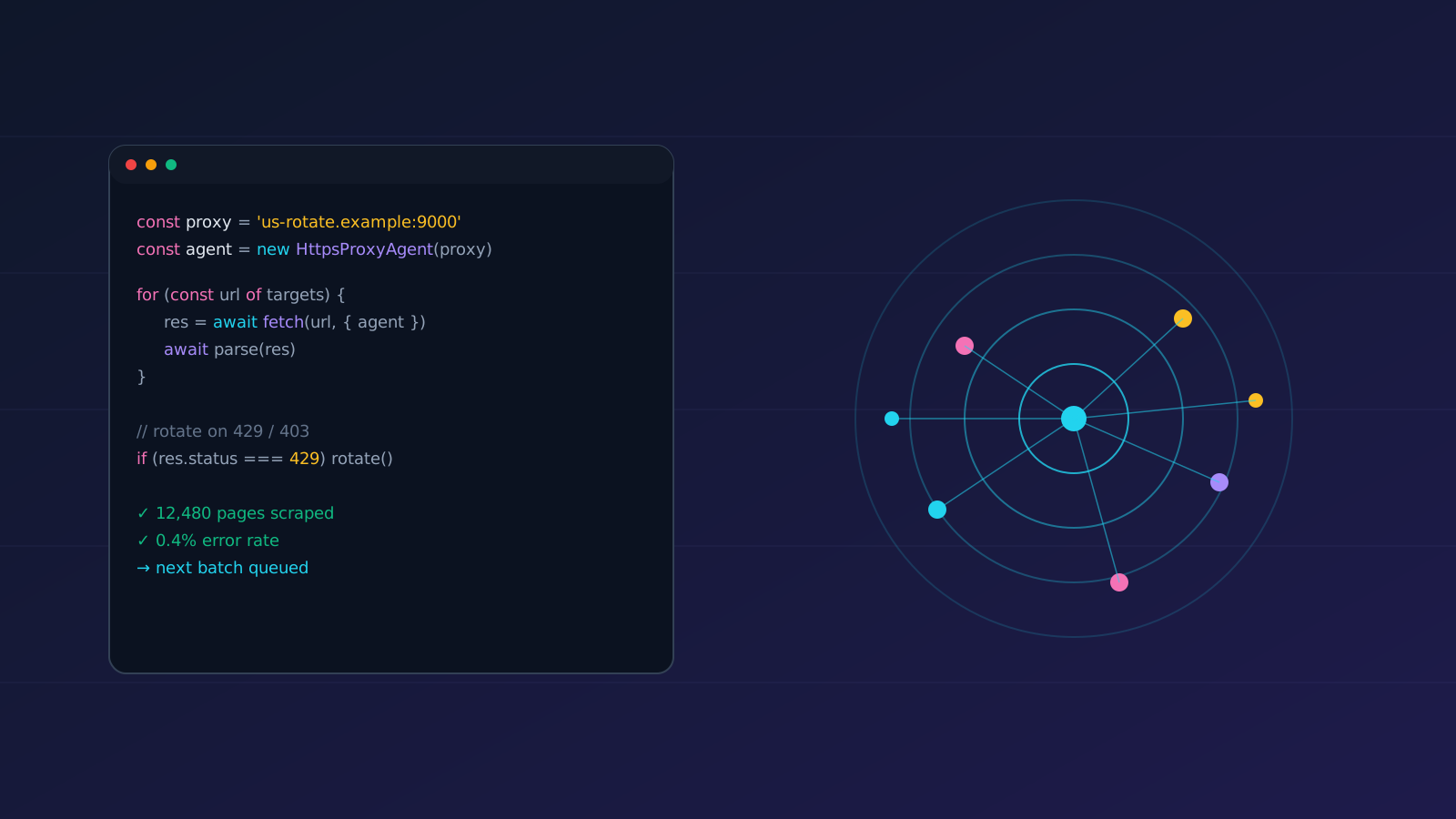
Implementing playwright proxies in Node.js or Python requires a specific syntax to ensure the browser binary correctly routes traffic. Below is a robust implementation using Node.js that handles proxy authentication and basic error handling. Note how the proxy details are passed during the creation of the browser instance.
const { chromium } = require('playwright');

(async () => {
  // Define proxy settings
  const proxySettings = {
    server: 'http://proxy.example.com:8080',
    username: 'your_username',
    password: 'your_password'
  };

  // Launch browser with proxy
  const browser = await chromium.launch({
    proxy: {
      server: proxySettings.server,
      username: proxySettings.username,
      password: proxySettings.password
    },
    headless: true // Set to false for debugging
  });

  const context = await browser.newContext({
    userAgent: 'Mozilla/5.0 (Windows NT 10.0; Win64; x64) AppleWebKit/537.36 (KHTML, like Gecko) Chrome/115.0.0.0 Safari/537.36'
  });

  const page = await context.newPage();

  try {
    await page.goto('https://api.ipify.org?format=json');
    const content = await page.textContent('body');
    console.log('Successfully connected via proxy:', content);
  } catch (error) {
    console.error('Failed to connect:', error.message);
  }

  await browser.close();
})();
Beyond basic implementation, advanced users should utilize specialized plugins. The playwright-extra package, combined with the stealth plugin, helps evade detection by modifying properties like navigator.webdriver and patching permissions. This is often necessary when scraping sites protected by Cloudflare or Akamai. For those needing stable performance, a 15% saving on Oxylabs datacenter proxies provides the necessary stability for heavy-lifting tasks.
Why Latency and Success Rates Matter
Efficiency is measured by the Success-to-Latency ratio. A proxy that is 100ms faster but fails 20% of the time is more expensive than a slower, more reliable one due to the cost of retries and potential IP bans. In our recent benchmarks, we've analyzed how different protocols impact the performance of Playwright scripts.
Benchmark Data (HTTP vs. SOCKS5)
- Residential HTTP Latency: 850ms average response time.
- Residential SOCKS5 Latency: 720ms average response time.
- Datacenter HTTP Latency: 110ms average response time.
- Datacenter Success Rate: 65% on Tier-1 e-commerce sites.
- Residential Success Rate: 98.4% on Tier-1 e-commerce sites.
For large-scale operations, utilizing a service like 5-proxy.com can provide the necessary bandwidth for high-thread-count environments. High-performance scraping often involves launching 50+ headless instances simultaneously. In such scenarios, the bandwidth consumption of the proxy gateway becomes a bottleneck.
Handling Geo-Targeting and IP Rotation
Most professional scraping tasks require data from specific regions. If you are scraping Google Search results for SEO audits, you must ensure your proxy is located in the target country to receive relevant results. Playwright handles this by connecting to a gateway that supports sub-domain or port-based geo-targeting. For example, us-pr.oxylabs.io:10001 might route you specifically through a New York-based residential node.
When rotating IPs, you have two choices:
- Gateway Rotation: Your proxy provider handles the switch. You connect to one endpoint, and they change the IP behind the scenes. This is easiest to implement in Playwright.
- Logic-Based Rotation: Your script manages a list of individual proxy IPs and creates a new
browserContextfor each one. This provides more control but increases memory consumption and overhead.
For developers seeking managed solutions, visiting proxytrust.site provides access to vetted lists of high-uptime providers that specialize in geo-targeted pools. Proper rotation prevents "pattern detection"—where a site notices a single user navigating 1,000 pages in 60 seconds.
Bypassing Advanced Bot Detection
Playwright, by default, is easily detectable by advanced WAFs (Web Application Firewalls). Even with a high-quality residential proxy, your playwright proxies setup might fail if the browser fingerprint is inconsistent. Consistency means the IP's timezone, MTU (Maximum Transmission Unit), and ISP headers match the browser's fingerprint (screen resolution, GPU vendor, and system fonts).
Using platforms like proxyip.top to source IPs with clean reputations is essential when targeting sites with "PerimeterX" or "DataDome" protection. Furthermore, you should emulate human-like behavior by injecting random delays and jitter into your Playwright actions.
// Example of human-like interaction in Playwright
await page.mouse.move(Math.random() * 500, Math.random() * 500);
await page.waitForTimeout(Math.floor(Math.random() * 2000) + 500);
await page.click('#search-button', { delay: Math.random() * 100 });
Reliable VPS infrastructure is also a factor in scraping success. If your local machine lacks the necessary resources to run multiple Playwright instances, consider migrating your scrapers to a provider listed on vpsrated.com/proxy, which ranks virtual private servers optimized for network-heavy scrapers.
Recommended Deals
- 25% Off Residential Proxy Plans — Get deep discounts on large-scale residential pools for Playwright.
- 15% Off Oxylabs Datacenter Proxies — Save on high-speed, dedicated IPs for stable scraping tasks.
Optimizing for Memory and Speed
Running headless browsers like Chromium is resource-intensive. Every time you launch a Playwright instance with a proxy, the browser spawns multiple processes. To optimize:
- Disable Heavy Assets: Block images, CSS, and fonts if you only need the HTML data.
- Reuse Contexts: Don't restart the browser for every URL; instead, clear cookies or rotate the proxy at the context level.
- Use Launch Options: Pass
--disable-dev-shm-usageand--no-sandboxif running in Docker containers.
For those conducting advanced SEO research using tools like Semrush or Ahrefs, automating the extraction of competitor backlinks involves high-volume requests that strictly require proxies to avoid account flagging. Similarly, if your scraper is hosted on a service like Hostinger or another cloud provider, the public IP of the server is likely already blacklisted by major CDNs, making the use of external proxies non-negotiable.
Troubleshooting Common Issues
If your Playwright script returns a 403 Forbidden or 407 Proxy Authentication Required error, the problem usually lies in the proxy configuration or the credential string. Ensure that special characters in your proxy password are URL-encoded. If you are using SOCKS5, verify that your Playwright version is up-to-date, as older versions had limited support for the SOCKS5 authentication handshake.
Another common failure point is the mismatch between the proxy's location and the website's default currency or language. If you use a Japanese proxy to access a US site, you might trigger a "region lock" page, which a basic scraper might interpret as data. Always validate the page content or title before proceeding with parsing.
FAQ
How do I rotate proxies automatically in Playwright?
Most modern providers offer a "backconnect" gateway. You simply enter a single hostname and port into Playwright's proxy settings, and the provider's server automatically switches the exit IP for you on every new request or session.
Can I use SOCKS5 proxies with Playwright?
Yes, Playwright fully supports SOCKS5. When defining your server URL, use the socks5:// prefix. This is often preferred for more secure, lower-level data transmission that bypasses some transparent HTTP proxies.
Does Playwright work with free proxies?
While it is technically possible, free proxies are extremely unstable, slow, and often harvest your data. For professional scraping, it is highly recommended to use paid residential or datacenter providers to ensure data integrity and script uptime.
How do I avoid being detected while using Playwright?
Combine high-quality residential proxies with the playwright-extra stealth plugin. Additionally, randomize user agents, avoid fixed patterns in navigation, and ensure your proxy IP matches the timezone and locale settings of your browser context.
By mastering the integration of Playwright and premium proxy services, you create a resilient extraction engine capable of navigating the most complex web landscapes. Whether you are tracking global market fluctuations or gathering training data for AI models, the combination of headless automation and clean IP rotation is the gold standard for modern web engineering.
For the latest discounts on the tools mentioned in this guide, check out our full list of proxy coupons.
Get the weekly ProxyPromo brief
Fresh deals, hand-tested codes and honest reviews — every Friday. No spam.