How to Build a Data Pipeline: Proxy → Scraper → Warehouse
Architecting a high-scale data pipeline requires a precise orchestration between network requests, parsing logic, and storage integrity. When you scale fro…
In this article
- The Architectural Blueprint of Modern Data Pipelines
- Selecting the Right Proxy Logic for Extraction
- Proxy Performance Benchmarks
- Developing the Scraper: Logic and Anti-Fingerprinting
- Data Warehousing and the Persistence Layer
- Latency and Throughput Analysis
- Security and Privacy in Data Pipelines
- Scaling with Containerization and Orchestration
- Recommended Infrastructure Stack
- Recommended Deals
- FAQ
- What is the difference between a proxy and a scraper?
- Why do I need a data warehouse instead of a regular database?
- How do I handle CAPTCHAs in my pipeline?
- Is scraping legal if I use proxies?
Architecting a high-scale data pipeline requires a precise orchestration between network requests, parsing logic, and storage integrity. When you scale from local scripts to enterprise-grade extraction, the bottleneck invariably shifts from code efficiency to IP reputation and throughput management.
The Architectural Blueprint of Modern Data Pipelines
A robust data pipeline follows a linear progression of data states, but the infrastructure supporting these states must be highly distributed. The journey begins with the Access Layer, where your scraper interfaces with the public internet. At this stage, the primary objective is anonymity and bypass capability. Without a 20% discount on residential proxies, costs for high-volume rotating IPs can quickly erode the ROI of a scraping project.
The second stage is the Extraction Layer. Here, headless browsers like Playwright or Puppeteer, or lightweight libraries like BeautifulSoup, transform raw HTML into structured JSON or CSV. Finally, the Persistence Layer handles the ingestion into a data warehouse or lake, ensuring that the structured data is versioned and searchable for downstream analytics.
Text alternative
flowchart TD
    A[Cloud Trigger] --> B[Proxy Rotator]
    B --> C{IP Health Check}
    C -->|Blocked| B
    C -->|Success| D[Headless Scraper]
    D --> E[HTML Parser]
    D --> F[Screenshot/Metadata]
    E --> G[Validation Schema]
    G --> H[(Data Warehouse)]
Selecting the Right Proxy Logic for Extraction
The choice of proxy determines the success rate of your pipeline. Datacenter proxies offer raw speed and low latency but are easily flagged by sophisticated Web Application Firewalls (WAFs) like Cloudflare or Akamai. For data pipelines targeting e-commerce giants or social media platforms, residential proxies are mandatory. These IPs are sourced from real household devices, making your scraper's traffic indistinguishable from organic users.
When configuring your proxy layer, you must decide between a rotating gateway and a sticky session. A rotating gateway provides a new IP for every request, which is ideal for broad scrapes of different URLs. Sticky sessions, typically lasting 1-30 minutes, are necessary when your scraper needs to navigate a multi-step checkout or login flow where the IP must remain constant to avoid session invalidation. Managing these flows requires a reliable backend, often hosted on high-performance infrastructure like Hostinger services to handle the concurrent request overhead.
Proxy Performance Benchmarks
| Provider | Pool Size | Success Rate | Latency | Protocol Support |
|---|---|---|---|---|
| Bright Data | 72M+ | 99.2% | 0.45s | HTTP/S, SOCKS5 |
| Oxylabs | 100M+ | 99.4% | 0.48s | HTTP/S, SOCKS5 |
| Smartproxy | 55M+ | 98.6% | 0.61s | HTTP/S |
| SOAX | 8M+ | 97.5% | 0.72s | HTTP/S, SOCKS5 |
| IPRoyal | 2M+ | 96.8% | 0.85s | SOCKS5, HTTP/S |
Evaluating these providers often involves testing their ability to circumvent specific bot detection mechanisms. Many developers use specialized proxy trust assessments to verify if the IPs assigned to their pool are flagged as "high risk" before deploying them into a live production pipeline.
Developing the Scraper: Logic and Anti-Fingerprinting
Modern web scraping is no longer just about fetching HTML; it’s about simulating human behavior. Sites now look for browser fingerprints—a combination of canvas rendering, screen resolution, font lists, and WebGL signatures. If your scraper uses a default Selenium configuration, you will be blocked even with a premium proxy.
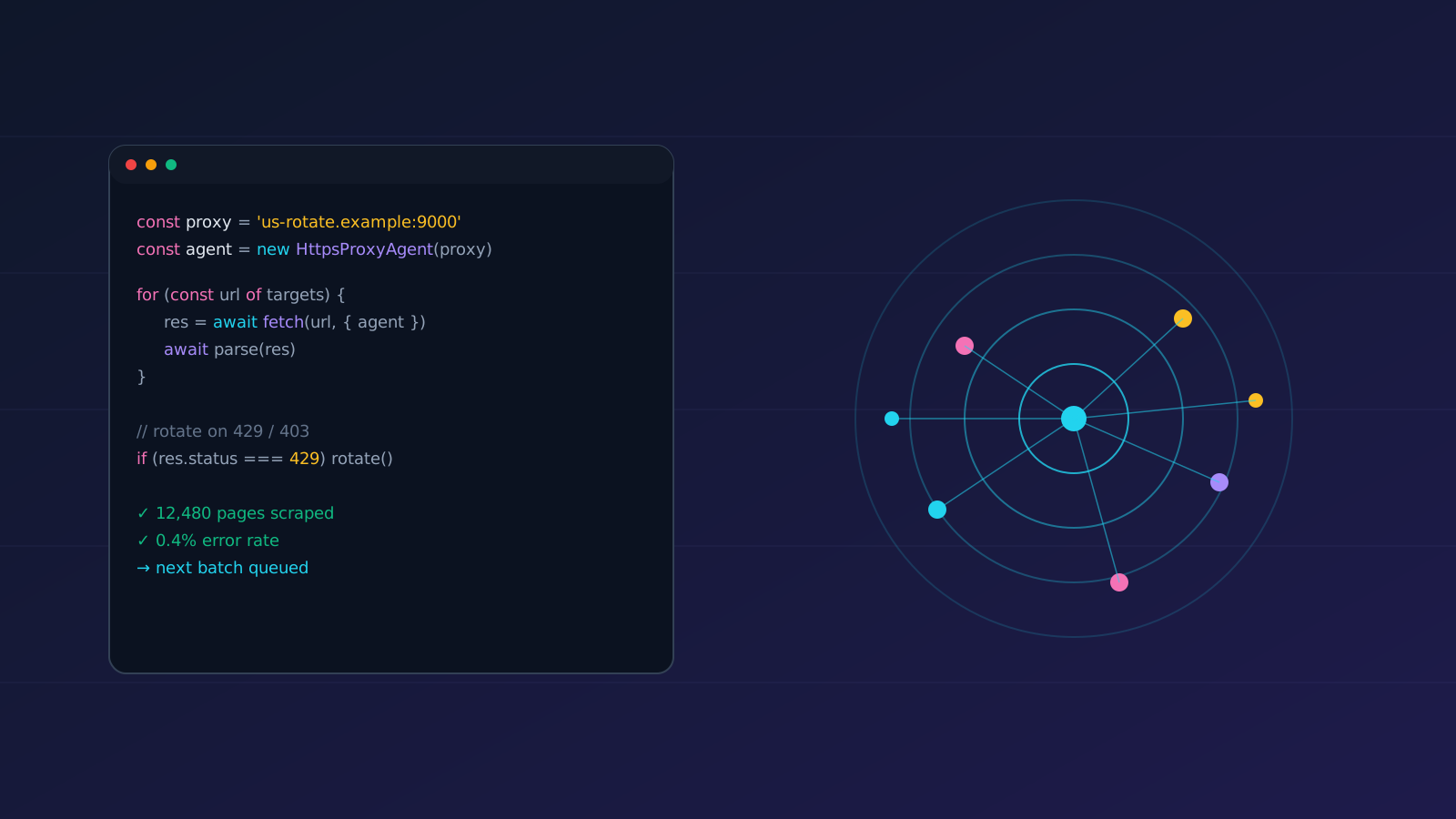
To build a resilient scraper, you should integrate "stealth" plugins that patch the navigator.webdriver property and randomize headers. Your scraper should also implement a "retry with backoff" strategy. If a 403 Forbidden or 429 Too Many Requests error occurs, the pipeline should automatically switch to a new proxy node and wait an increasing duration before re-attempting the request.
import requests

# Example of a rotating residential proxy integration
proxy_options = {
    "http": "http://user-country-us-session-rand123:password@proxy.provider.com:8000",
    "https": "http://user-country-us-session-rand123:password@proxy.provider.com:8000"
}

def fetch_data(url):
    try:
        response = requests.get(url, proxies=proxy_options, timeout=30)
        response.raise_for_status()
        return response.text
    except requests.exceptions.HTTPError as err:
        print(f"Proxy blocked or URL invalid: {err}")
        return None

# Usage in a pipeline
raw_html = fetch_data("https://www.target-site.com/products")
For large-scale operations, utilizing a dedicated proxy IP service can provide a consistent footprint for SEO monitoring tools. In many cases, developers leverage third-party SEO suites like Semrush or Ahrefs to validate the data they scrape against industry standards.
Data Warehousing and the Persistence Layer
Once data is extracted and parsed, it must be stored in a format that supports high-velocity writes and complex queries. A standard data pipeline uses a staging area (like Amazon S3 or Google Cloud Storage) before moving data into a warehouse like Snowflake, BigQuery, or Amazon Redshift.
The conversion from unstructured HTML to structured relational data involves a schema validation step. Tools like Pydantic in Python ensure that if a price field is expected as a float, the pipeline doesn't break if the scraper accidentally captures a currency symbol. This "Shift Left" approach to data quality prevents the warehouse from becoming a "data swamp."
Latency and Throughput Analysis
- Datacenter Proxies: 50ms - 150ms latency | 95% Success (Low-security sites)
- Residential Proxies: 400ms - 900ms latency | 99% Success (High-security sites)
- Mobile Proxies (4G/5G): 600ms - 1200ms latency | 99.9% Success (Strict mobile apps)
- Internal Parsing Overload: 10ms - 50ms per page
- Warehouse Ingestion (Batch): 2s - 10s per 10k rows
For developers looking for high-performance virtual environments to host these ingestion scripts, checking VPS ratings for proxy tasks can help identify providers with the lowest network jitter.
Security and Privacy in Data Pipelines
Security must be two-fold: protecting your scraper from detection and protecting the harvested data. When handling sensitive datasets, using a VPN can add an extra layer of encryption for the developers managing the backend. Services like NordVPN, ExpressVPN, or ProtonVPN are frequently used to secure the administrative SSH connections to the scraping servers.
Furthermore, you must ensure that your data pipeline complies with legal frameworks such as the GDPR or CCPA. This means stripping Personally Identifiable Information (PII) during the Parsing stage before the data ever reaches the Warehouse. Integrating a verified proxy source ensures that the IPs you use are ethically sourced, which is a critical component of corporate compliance audits.
Scaling with Containerization and Orchestration
A single script running on a loop is not a pipeline. To scale, you should containerize your scraper using Docker and orchestrate the tasks using a tool like Apache Airflow or Prefect. This allows you to run hundreds of scraping instances in parallel, each utilizing different segments of your proxy pool.
Containerization allows for easier environment replication. If a scraper works on your local machine, it will work on a Production node. You can also implement "Health Checks" where the orchestrator kills a container if its proxy success rate drops below 80%, automatically spinning up a new instance with a fresh configuration. This self-healing architecture is what separates amateur hobbyist scripts from professional data engineering.
Recommended Infrastructure Stack
- Orchestrator: Apache Airflow
- Access: 20% off all residential proxies
- Compute: Hostinger VPS
- Storage: Snowflake or PostgreSQL
- Monitoring: Grafana with Prometheus
For more insights into optimizing your server requests, visit our guide on advanced proxy rotation strategies.
Recommended Deals
- 20% Off All Residential Proxies — Save on high-success rate residential IPs for heavy scraping.
- Hostinger 75% Off Premium Hosting — Affordable and fast VPS for hosting your data pipelines.
FAQ
What is the difference between a proxy and a scraper?
A proxy is a network intermediary that masks your IP address, while a scraper is the actual code (or software) that navigates a website and extracts data. In a pipeline, the scraper sends its traffic through the proxy to avoid being blocked by the target website.
Why do I need a data warehouse instead of a regular database?
Data warehouses like BigQuery or Snowflake are optimized for analytical queries (OLAP) over massive datasets, whereas regular databases (OLTP) like MySQL are better for day-to-day application transactions. For a data pipeline focused on insights, a warehouse provides significantly better performance.
How do I handle CAPTCHAs in my pipeline?
While residential proxies reduce CAPTCHA frequency, some sites will still trigger them. You can integrate third-party CAPTCHA solving APIs or use browser-based tools like Bright Data's Web Unlocker which automatically handles solvers and retries at the proxy level.
Is scraping legal if I use proxies?
Web scraping is generally legal for publicly accessible data, but you must respect the site's Terms of Service, Robots.txt, and data privacy laws like GDPR. Using proxies helps manage request volume to avoid "Denial of Service" scenarios, but it does not exempt you from legal compliance.
Building a high-performance data pipeline is a continuous process of refinement. By balancing the cost-efficiency of your proxy pool with the robustness of your scraping logic and the scalability of your warehouse, you can create a reliable flow of information that drives business intelligence. Ready to start building? Check out our latest coupon deals to save on the essential tools for your stack.
Get the weekly ProxyPromo brief
Fresh deals, hand-tested codes and honest reviews — every Friday. No spam.