How Sneaker Bots Use Proxies to Cop Limited Drops
Successful sneaker copping requires a technical synergy between high-frequency automation and distributed networking. When platforms like Shopify, Nike SNK…
In this article
- The Architecture of Automated Sneaker Procurement
- Why Residential Proxies are the Gold Standard
- Performance Benchmarks by Proxy Type
- The Mechanics of Proxy Rotation and Sticky Sessions
- A Typical Python Snippet for Proxy Integration
- Bypassing Advanced Anti-Bot Safeguards
- The Role of Geo-Locating Proxies for Regional Drops
- Latency Comparison by Region (Sample Data)
- Managing Proxy Costs and Bandwidth Consumption
- Recommended Deals
- Enhancing Success with CAPTCHA Solvers and Proxies
- Conclusion: The Future of Sneaker Botting
- FAQ
- What is the difference between ISP and Residential proxies?
- How many proxies do I need for a single sneaker drop?
- Can I use a VPN for sneaker botting instead of proxies?
- Why do my proxies work on one site but not another?
Successful sneaker copping requires a technical synergy between high-frequency automation and distributed networking. When platforms like Shopify, Nike SNKRS, or Supreme release high-demand inventory, the milliseconds saved by low-latency connections and the invisibility granted by residential IP pools determine who hits a checkout and who receives a "Product Sold Out" notification.
The Architecture of Automated Sneaker Procurement
To understand how sneaker bots use proxies, one must first understand the bottleneck inherent in standard web browsing. A manual user provides a single IP address and a single point of failure; if a site detects too many requests from that IP, it triggers a CAPTCHA or a direct ban. Sneaker bots circumvent this by distributing hundreds of tasks across thousands of unique IP addresses. This mimics the behavior of a crowd of disparate users rather than a single script.
Modern bots like Wrath, MEKPreme, or Ganesh are designed to handle multi-threading. Each thread acts as an independent customer. Without a proxy, these threads would all share the same source IP, leading to an immediate IP range ban from the target website's firewall (such as Akamai or Cloudflare). By integrating proxies, the bot assigns a unique identity to each task, allowing for simultaneous "Add to Cart" and "Checkout" requests without raising red flags.
Text alternative
graph TD
  A[Sneaker Bot Interface] --> B[Task 1: Size 9]
  A --> C[Task 2: Size 10]
  A --> D[Task 3: Size 11]
  B --> E[Proxy IP 1]
  C --> F[Proxy IP 2]
  D --> G[Proxy IP 3]
  E --> H[Target: Nike SNKRS]
  F --> H
  G --> H
  H --> I{Success/Fail}
  I --> J[Bot Logic: Webhook Notification]
Why Residential Proxies are the Gold Standard
In the sneaker world, all IPs are not created equal. Data center proxies, while fast, are often flagged because their subnets belong to known providers like AWS or DigitalOcean. E-commerce platforms use advanced fingerprinting to identify these ranges. Residential proxies, conversely, are IPs assigned by Internet Service Providers (ISPs) to real homeowners. When a bot uses a residential IP, the target website sees the request as coming from a standard Comcast or Verizon FIIOS customer.
For users targeting high-value releases, obtaining a discount on high-quality traffic is essential. You can currently get 20% off all residential proxies to lower your operational costs. These residential pools allow you to bypass perimeter security layers by rotating your IP address for every single request or maintaining a "sticky session" for the duration of the checkout flow.
Performance Benchmarks by Proxy Type
| Proxy Category | Avg. Latency (ms) | Success Rate | Detection Risk | Recommended Use Case |
|---|---|---|---|---|
| ISP/Static Resi | 30-80ms | 92% | Low | Initial drops & queue bypass |
| Rotating Resi | 150-400ms | 85% | Very Low | Mass tasking & scraping |
| Datacenter (DC) | 10-25ms | 35% | High | Restocks & high-speed pinging |
| Mobile 4G/5G | 200-500ms | 98% | Negligible | Difficult sites (Nike, Yeezy Supply) |
The Mechanics of Proxy Rotation and Sticky Sessions
Rotation is the process where a proxy gateway assigns a new IP from the pool to each outgoing request. This is vital during the "site monitoring" phase. If your bot is checking the stock levels of a Jordan 1 Retro every 2 seconds from the same IP, it will be banned within minutes. By rotating through a pool of 50 million+ IPs, the bot can monitor at high frequencies without any single IP staying active long enough to be flagged.
However, once an item is in the cart, you need a "sticky session." This ensures that the IP address remains constant throughout the checkout process. If the IP changes after the item is in the cart, the website may view the session as hijacked or suspicious, resulting in a "session expired" error. Providers like Smartproxy and Oxylabs allow you to set the duration of these sessions, typically ranging from 1 to 30 minutes.
A Typical Python Snippet for Proxy Integration
import requests

# Example of a sticky residential proxy usage
proxy_host = "p.provider.com"
proxy_port = "7000"
proxy_user = "user-session-abc123" # The session suffix makes it sticky
proxy_pass = "password"

proxies = {
    "http": f"http://{proxy_user}:{proxy_pass}@{proxy_host}:{proxy_port}",
    "https": f"http://{proxy_user}:{proxy_pass}@{proxy_host}:{proxy_port}"
}

def attempt_checkout(target_url):
    try:
        response = requests.get(target_url, proxies=proxies, timeout=5)
        if response.status_code == 200:
            print("Successfully reached product page.")
    except Exception as e:
        print(f"Proxy failed: {e}")

attempt_checkout("https://www.example-sneaker-site.com/products/limited-drop")
Bypassing Advanced Anti-Bot Safeguards
Platforms like Shopify and Foot Locker use sophisticated tools like PerimeterX and Datadome. These tools don't just look at IPs; they analyze browser fingerprints, mouse movements, and TLS handshakes. Even with the best proxies, if your bot's header information doesn't match the residential nature of the IP, you will be caught.
Senior botters often employ ISP Proxies (also known as Static Residential Proxies). These are hosted in data centers but use IP addresses registered under consumer ISPs. They offer the blazing speed of a data center (10Gbps uplinks) with the trust score of a residential user. When combined with a 25% off residential proxies discount, these become the most cost-effective way to secure multiple pairs without the lag associated with back-connect rotating pools.
To further increase success, look into advanced rotating residential services that offer specialized sneaker pools. These pools are sanitized to remove IPs that have been recently banned by major retailers.
The Role of Geo-Locating Proxies for Regional Drops
Many sneaker releases are region-locked. A drop might occur exclusively on Nike's UK site or a specific boutique in Berlin. If you attempt to access these from a US-based IP, you will either be redirected or blocked. Sneaker bots allow you to select the country, city, or even the specific ISP of your proxies.
For example, if a drop is happening in Japan, configuring your bot to use SOAX or Bright Data IPs located in Tokyo reduces the physical distance between your "virtual" self and the hosting server. This reduction in round-trip time (RTT) can be the difference between a successful checkout and a "Sold Out" screen. You can find more information on top-tier regional performance at ProxyTrust.
Latency Comparison by Region (Sample Data)
- US-East to Shopify (Virginia):
- Residential: 45ms
- ISP: 12ms
- DC: 5ms
- EU-West to Adidas (Germany):
- Residential: 68ms
- ISP: 22ms
- DC: 9ms
- Asia-East to Nike (Tokyo):
- Residential: 110ms
- ISP: 35ms
- DC: 15ms
Managing Proxy Costs and Bandwidth Consumption
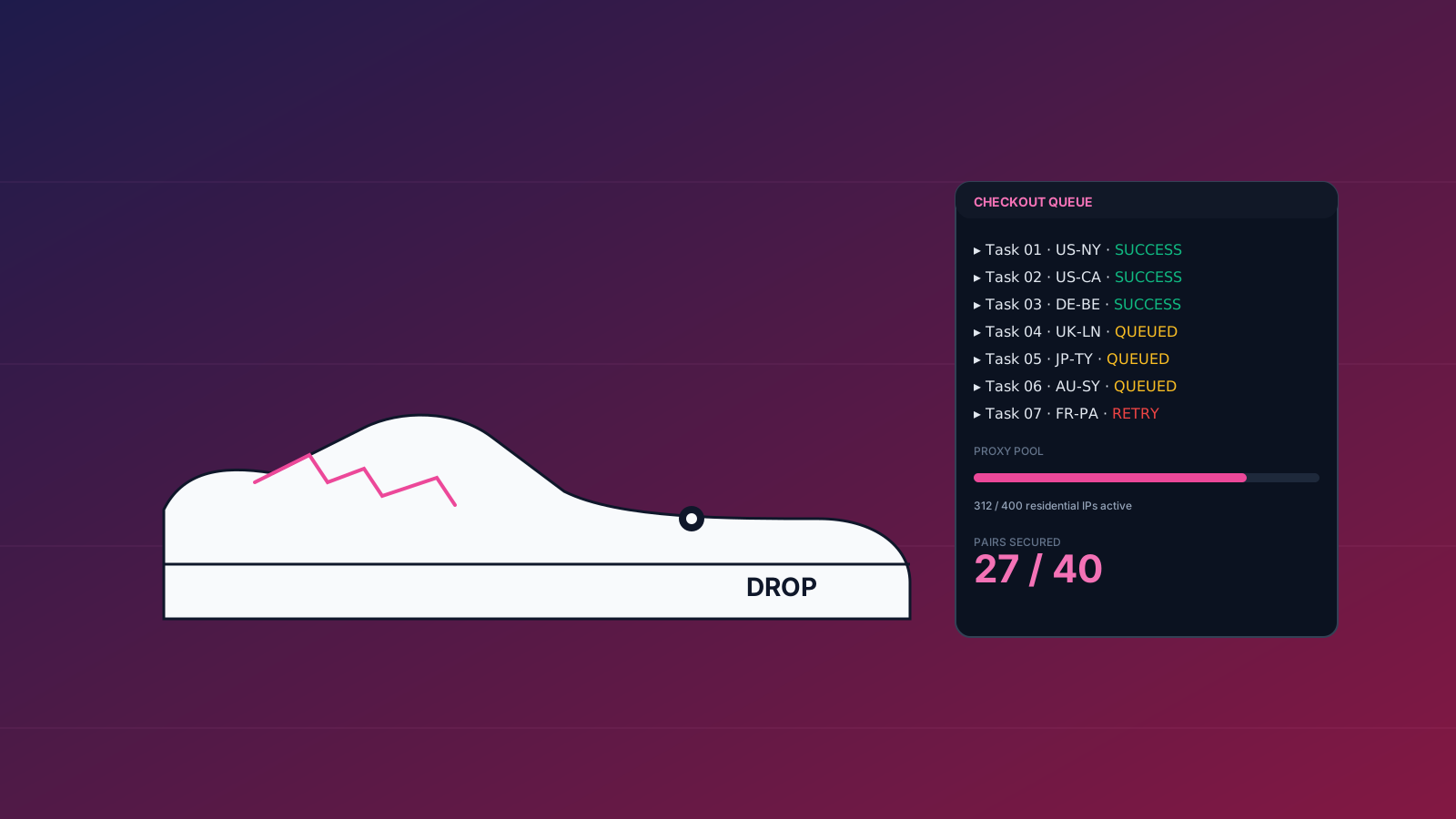
One mistake novice botters make is leaving their tasks running on residential proxies while the bot is merely "idling" or monitoring. Residential proxies are usually billed per gigabyte (GB). Because bots download images, scripts, and CSS files for every task, a single task can consume 5-10MB per minute. If you are running 500 tasks, you could burn through 5GB in under an hour.
To optimize, users often use Datacenter Proxies for monitoring (since they usually offer unlimited bandwidth) and switch to Residential Proxies only when the "checkout" signal is triggered. Furthermore, utilizing tools like Semrush or Ahrefs to analyze site changes beforehand can help refine your bot's scripts to only request the minimum necessary data, saving you money on your data plan.
When you are ready to scale up, checking reliable review sites like ProxyIP.top or comparing infrastructure on VPSRated Proxy can help you avoid providers with high failure rates.
Recommended Deals
- 20% Off All Residential Proxies — Save on massive proxy pools for large-scale drops.
- 25% Discount on Residential Traffic — Get premium IP addresses with a significant price reduction.
Enhancing Success with CAPTCHA Solvers and Proxies
Proxies are only half the battle. When a bot hits a site too hard, the site serves a CAPTCHA. The reputation of your proxy IP directly influences the difficulty of the CAPTCHA you receive. If your IP has a high trust score (which residential IPs typically do), you might receive a "one-click" ReCaptcha where you simply check a box. If the IP is flagged, you might face an endless loop of selecting "identify all street signs" photos.
Using a proxy with a clean history is paramount. Providers like IPRoyal and ProtonVPN (for their dedicated IP offerings) are often cited for their clean pools. Integrating these with high-quality CAPTCHA solving services like 2Captcha or CapMonster, which also use their own proxies to return the solved token back to your bot, creates a seamless automated flow.
Conclusion: The Future of Sneaker Botting
As retailers move toward more aggressive anti-scraping technologies like "hCaptcha" and blockchain-based queuing, the demand for highly specialized proxies will only increase. Success in this field requires constant adaptation. It is no longer enough to just have a bot; you must have a diverse portfolio of ISP, residential, and mobile proxies to counter whatever defensive measures a retailer implements on drop day.
By carefully managing your internal link to residential proxy offers and staying updated on the latest firmware versions of your favorite bots, you can maintain a competitive edge. The sneaker market remains a multi-billion dollar industry where the right network setup pays for itself with a single successful cop.
FAQ
What is the difference between ISP and Residential proxies?
ISP proxies are hosted in data centers but use residential IP addresses provided by ISPs, offering a mix of high speed and high trust. Traditional residential proxies are sourced from actual home devices (P2P networks), offering the highest anonymity but generally slower speeds.
How many proxies do I need for a single sneaker drop?
A good rule of thumb is a 1:1 or 2:1 ratio of proxies to tasks. If you are running 100 tasks on a Shopify site, you should have at least 100-200 residential proxies to ensure that if one IP is banned, the other tasks can continue without interference.
Can I use a VPN for sneaker botting instead of proxies?
While services like NordVPN or ExpressVPN are excellent for privacy, they generally provide a single IP address per connection. This is insufficient for "botting" which requires hundreds of unique identities simultaneously. VPNs are better for manual copping on a single browser.
Why do my proxies work on one site but not another?
Sites like Nike SNKRS have much stricter IP filtering than smaller Shopify boutiques. Your proxies may be "flagged" on Nike's internal database but still appear "clean" to a smaller retailer. Always test your proxies on the specific target site 15 minutes before the drop.
For more information on the best tools for your automation needs, visit our comprehensive proxy coupon section.
Get the weekly ProxyPromo brief
Fresh deals, hand-tested codes and honest reviews — every Friday. No spam.