Best VPN vs Best Proxy: Which Should You Pick in 2026?
Choosing between a VPN and a proxy has evolved from a simple binary choice into a complex architectural decision. By 2026, the lines have blurred as provid…
In this article
- Understanding the Core Architecture: VPN vs Proxy
- Protocol Comparison: WireGuard, SOCKS5, and HTTP/S
- Encryption and Privacy: Where Most Users Get Confused
- Performance and Speed Benchmarks
- Web Scraping and Automation: The Proxy Stronghold
- Recommended Deals
- Geo-Spoofing and Content Access
- Corporate Use Cases: Zero Trust and Remote Work
- Security Vulnerabilities of Free Proxies and VPNs
- Hybrid Solutions: Using Both Simultaneously
- Ease of Configuration and Setup
- Final Verdict: Choosing Your Infrastructure
- Frequently Asked Questions
- Which is faster: a VPN or a Proxy?
- Can a proxy hide my browsing from my ISP?
- Is it legal to use a VPN/Proxy for web scraping?
- Does a VPN protect me from malware?
Choosing between a VPN and a proxy has evolved from a simple binary choice into a complex architectural decision. By 2026, the lines have blurred as providers integrate features from both worlds. However, understanding the underlying differences in encryption, protocol overhead, and session management remains critical for scraping operations, streaming, and corporate security.
Whether you need to bypass a simple geo-fence or manage thousands of automated browser instances, the choice depends on your specific use case. High-bandwidth activities like 4K streaming often favor VPNs for their system-wide stability, while large-scale data harvesting or multi-accounting requires the granular control and rotational capabilities of residential proxies.
Understanding the Core Architecture: VPN vs Proxy
At a fundamental level, both tools act as intermediaries. A proxy acts as a gateway that masks your IP address for specific applications (like a web browser or a script). A Virtual Private Network (VPN) creates an encrypted tunnel between your device and a server, routing all traffic from the entire operating system through that tunnel.
Typical proxies operate at the Application Layer (Layer 7 of the OSI model), whereas most modern VPNs operate at the Network Layer (Layer 3). This distinction is vital. If you are running a Python script with requests, you can pass a specific proxy URL just to that script. Conversely, if you connect to NordVPN, every packet from your OS—including background updates and system pings—is rerouted and encrypted.
Proxies: The Granular Intermediary
Proxies are lightweight. They do not typically encrypt the data passing through them (unless using SOCKS5 over SSH or specialized HTTPS proxies), which makes them faster for specialized tasks. In the proxy market, you will encounter:
- Datacenter Proxies: Fast, cheap, but easily detected.
- Residential Proxies: Real IP addresses from ISPs, making them nearly impossible to block.
- Mobile Proxies: IPs from 4G/5G networks, offering the highest trust scores.
VPNs: The Encrypted Tunnel
VPNs use protocols like WireGuard or OpenVPN to wrap your data in a layer of encryption. This is essential for privacy on public Wi-Fi or when you want to hide your browsing habits from your local ISP. Providers like ExpressVPN and NordVPN have standardized these protocols to ensure minimal latency, but the overhead of encryption means they are generally slower than a raw proxy connection.
Text alternative
graph LR
    A[User Device] --> B{Choose Tool}
    B -->|VPN| C[Encrypted Tunnel]
    B -->|Proxy| D[Application Level]
    C --> E[ISP/Global Traffic]
    D --> F[Specific App Traffic]
    E --> G((Internet))
    F --> G
Protocol Comparison: WireGuard, SOCKS5, and HTTP/S
In 2026, WireGuard has become the industry standard for VPNs, replacing the aging OpenVPN in most high-performance scenarios. WireGuard’s codebase is thousands of lines shorter, leading to faster handshake times and lower battery consumption on mobile devices.
Proxies, however, still rely heavily on SOCKS5 and HTTP/S. SOCKS5 is particularly versatile because it doesn’t care about the protocol (TCP or UDP) or the traffic type. This makes it ideal for P2P file sharing or gaming, where low-level packet handling is required. HTTP proxies are better suited for web scraping because they can interpret and modify headers, allowing for easier cookie management.
For developers, setting up a proxy in a Node.js environment might look like this:
const axios = require('axios');
const { HttpsProxyAgent } = require('https-proxy-agent');

const proxyAgent = new HttpsProxyAgent('http://user:pass@proxy-provider.com:8080');

axios.get('https://api.target-site.com/data', { httpsAgent: proxyAgent })
  .then(response => console.log(response.data))
  .catch(err => console.error(err));
By contrast, using a VPN requires the OS to establish the connection before the script runs. This lack of programmatic control is why choosing the right proxy for scraping is a common topic for data scientists who need to rotate IPs every few requests.
Encryption and Privacy: Where Most Users Get Confused
The biggest misconception in the "vpn vs proxy" debate is that proxies provide privacy. While a proxy hides your IP address from the destination website, it does not hide your traffic from your ISP or a malicious actor on a local network. If you use a transparent proxy, the ISP can still see that you are accessing specific URLs.
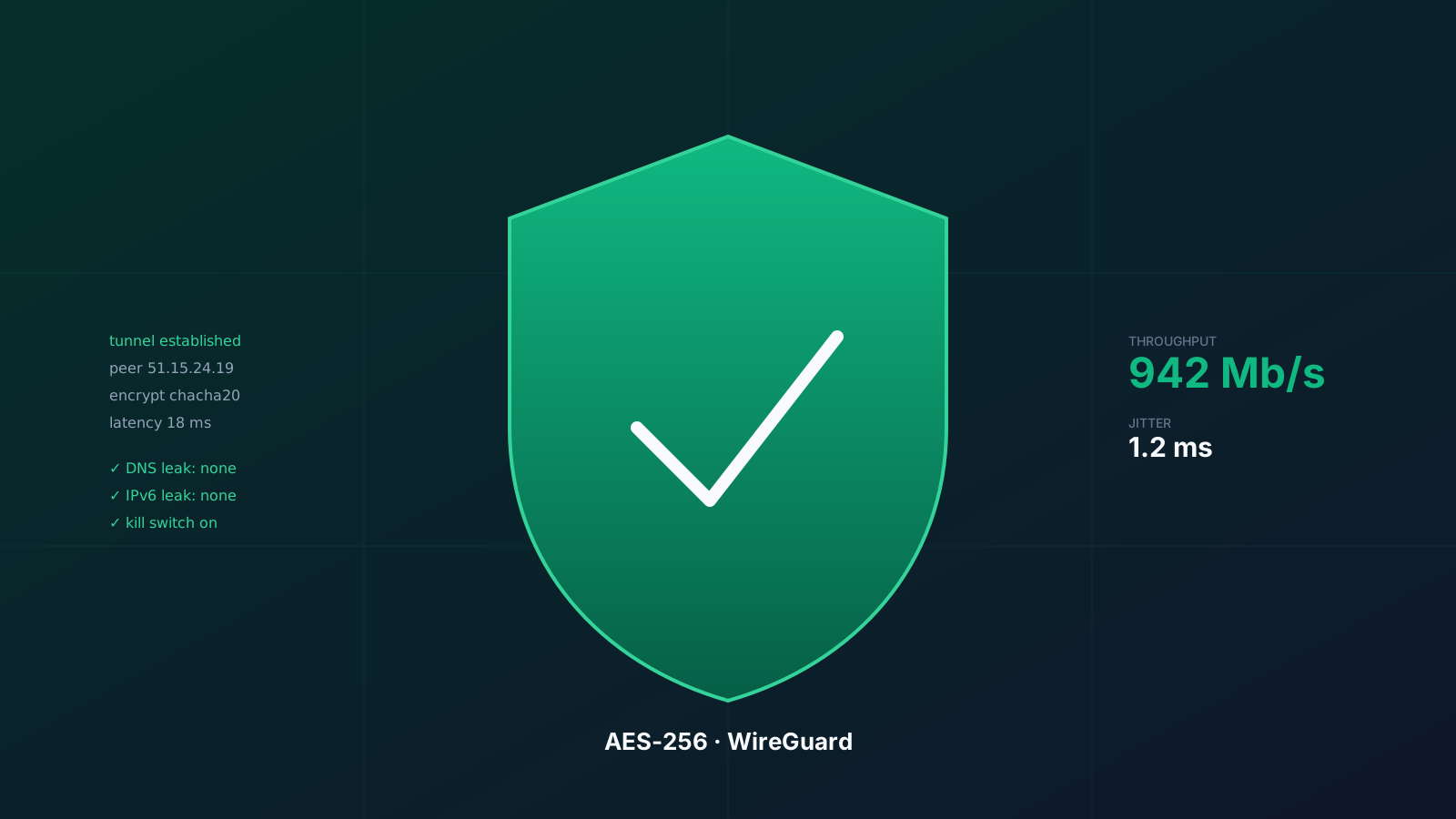
VPNs solve this by using AES-256 or ChaCha20 encryption. This ensures that even if someone intercepts your packets, they see nothing but encrypted gibberish. However, this comes at a price. If you are performing high-volume tasks—like scraping 1,000,000 pages an hour—the encryption overhead is a waste of CPU cycles. In these scenarios, high-speed datacenter proxies are the superior choice, as the data you are collecting is likely public and doesn't require end-to-end encryption.
Performance and Speed Benchmarks
Speed is subjective and depends on server proximity, but architecture dictates potential.
- Latency: Proxies usually have lower latency because they forgo the "handshake" and encryption steps required by VPNs.
- Throughput: VPNs can sometimes offer better throughput on congested networks because of UDP-based protocols that handle packet loss more gracefully than basic HTTP proxies.
- Stability: VPNs are designed for long-term "always-on" connections. Proxies are often designed for short-lived sessions or rotating bursts.
If you are a gamer trying to reduce ping, a specialized proxy or a "gaming VPN" using WireGuard is your best bet. If you are a marketer managing social accounts, you need a dedicated residential proxy to ensure that your Instagram or Facebook account isn't flagged for "suspicious login activity" stemming from a shared VPN IP address that hundreds of others are using.
| Feature | VPN (Virtual Private Network) | Proxy (SOCKS5/HTTP) |
|---|---|---|
| Encryption | Full System (AES-256/ChaCha20) | None or Application-level |
| Traffic Scope | System-wide (All apps) | Application-specific |
| Speed | Moderate (Encryption overhead) | High (Minimal overhead) |
| Anonymity | High (Hides activity from ISP) | Moderate (Hides IP from site) |
| Best For | Privacy, Security, Streaming | Web Scraping, Multi-accounting |
| Cost | Regular monthly subscription | Often based on GB usage |
Web Scraping and Automation: The Proxy Stronghold
The primary reason professional data miners don't use VPNs is the lack of "IP density." A VPN provider might have 5,000 servers. A residential proxy provider like Smartproxy or Bright Data has over 50 million IPs.
In web scraping, sites use "rate limiting." If they see 1,000 requests per minute from a single IP, they block it. With a VPN, you would need to manually disconnect and reconnect to a new server, which is inefficient. With a residential proxy pool, every single request can come from a different IP address, simulating a massive crowd of organic users.
Furthermore, proxies allow for "session persistence." You can tell the proxy server to keep you on the exact same IP for 30 minutes (sticky sessions) while you log in and navigate a site, then switch once the task is done. This level of control is impossible with a standard VPN setup. If you are interested in the technical specifics, check out our guide on how residential IPs work.
Recommended Deals
To help you get started with the right infrastructure, we have curated the best current offers for both categories. Whether you need the security of a VPN or the scalability of a residential proxy, these deals offer the best entry points:
- ExpressVPN Annual Discount — Get 49% off plus 3 months free on the industry's most reliable VPN.
- NordVPN 2-Year Plan — Huge 68% savings for secure, high-speed browsing and streaming.
- Smartproxy Residential Deal — Save 20% on all residential proxy plans for web scraping and automation.
Geo-Spoofing and Content Access
If your goal is to watch BBC iPlayer from the USA or Netflix Japan from Europe, a VPN is the superior choice. This is because streaming services have become extremely adept at detecting proxies. VPN providers like IPRoyal and Oxylabs maintain specialized servers that are constantly updated to evade these blocks.
Standard proxies often fail here because they lack the obfuscation technologies (like obfuscated servers or stealth mode) that hide the fact that you are using a proxy. Many video players test for the presence of specific headers or TCP fingerprints that proxies typically leave behind. A high-quality VPN replaces your entire network stack, making it much harder to detect.
For those looking for high-performance server options for their own setups, checking out VPS options for proxy hosting can be a cost-effective way to build a private geo-spoofing solution.
Corporate Use Cases: Zero Trust and Remote Work
In 2026, the traditional corporate VPN is being replaced by ZTNA (Zero Trust Network Access). However, for many small-to-medium enterprises, a VPN remains the easiest way to give employees access to internal files and local staging servers. In these environments, speed is less important than the "kill switch" and "split tunneling" features.
A kill switch ensures that if the VPN connection drops, all internet traffic is instantly cut off to prevent your real IP address or unencrypted data from leaking. Proxies do not offer this natively. If a proxy fails, the application usually just stalls or, worse, reverts to your direct, non-anonymous connection.
For businesses monitoring competitors' prices or ad placements, top-tier proxy trust rankings suggest using a mix of residential and mobile proxies to avoid being served "poisoned" data or fake prices by anti-scraping tools like Cloudflare or Akamai.
Security Vulnerabilities of Free Proxies and VPNs
It is worth noting that if you aren't paying for the product, you are the product. This is doubly true for the "Best VPN vs Proxy" debate. Free web proxies often inject ads into your browsing sessions or, in malicious cases, perform Man-in-the-Middle (MITM) attacks to steal cookies.
Free VPNs are just as dangerous. Research has shown that many free VPN apps on mobile stores contain malware or sell user bandwidth to botnet operators. If you need a reliable connection for professional work, always opt for vetted proxy services that publish their uptime and security audits. A small monthly investment prevents the catastrophic loss of sensitive data.
Hybrid Solutions: Using Both Simultaneously
Can you use a VPN and a proxy at the same time? Yes, and in some security-critical scenarios, you should. By running a proxy inside a VPN tunnel, you achieve two things:
- Double Hiding: Your ISP only sees the VPN, and the VPN provider only sees the proxy.
- Location Flexibility: You can set your VPN to a stable location (e.g., Switzerland) and then use a rotating proxy to jump between cities for localized scraping.
This "Double Hop" architecture is common among journalists working in high-risk zones. They use a VPN for general security and a SOCKS5 proxy within a browser like Tor for specific research. While this significantly slows down the connection, it provides the maximum possible layer of anonymity.
Ease of Configuration and Setup
For the average user, setting up a VPN involves downloading an app, logging in, and clicking "Connect." It is a plug-and-play solution.
Proxies require a bit more manual work. You often have to enter the IP, port, username, and password into a system settings menu or a browser extension like FoxyProxy. This barrier to entry is why VPNs have dominated the consumer market, while proxies have remained the tool of choice for the "power user" and the developer.
If you are looking for easy-to-use proxy providers, look for those that offer their own Chrome extensions, which bridge the gap between VPN simplicity and proxy functionality.
Final Verdict: Choosing Your Infrastructure
The winner of the VPN vs Proxy debate depends entirely on your intent:
- Choose a VPN if your priority is privacy, security on public networks, or simple geo-unblocking for streaming.
- Choose a Proxy if you are scraping data, managing multiple social media accounts, or need high-speed, non-encrypted connections for automated tasks.
As we move further into 2026, the technology behind both will continue to converge. We are already seeing "Proxy-style" rotation integrated into some VPN services and "VPN-style" encryption added to premium proxy packages.
Frequently Asked Questions
Which is faster: a VPN or a Proxy?
Generally, a proxy is faster because it does not have the computational overhead of encrypting and decrypting data. However, a VPN using the WireGuard protocol can often outperform a poorly optimized or overloaded public proxy.
Can a proxy hide my browsing from my ISP?
No. While a proxy masks your IP address from the websites you visit, your Internet Service Provider (ISP) can still see the traffic flowing to the proxy server and, unless that traffic is otherwise encrypted (like HTTPS), they can see what data is being sent.
Is it legal to use a VPN/Proxy for web scraping?
Web scraping is generally legal if you are accessing publicly available data. However, you must comply with regional laws (like GDPR) and the target site's Terms of Service. Using proxies helps avoid IP bans during these legal activities.
Does a VPN protect me from malware?
Some premium VPNs include DNS-based ad-blocking and malicious site filtering, but a VPN is not an antivirus. It encrypts your data in transit but will not stop you from downloading and executing a malicious file.
For the most up-to-date discounts on the industry's leading tools, explore our full directory of verified coupons and promo codes to secure your digital workflow today.
Get the weekly ProxyPromo brief
Fresh deals, hand-tested codes and honest reviews — every Friday. No spam.